
Are you passionate about the cosmos? Dive into this deep exploration of the theories about the origin of the universe. From the Big Bang to inflation and multiverses, we unveil all the scientific secrets in clear language. Come in and discover where we really come from!
Many times, we look at the sky and think that everything we see has always been there. But the truth is that the cosmos has a fascinating history full of critical moments. It’s not just that things appeared out of nowhere. There were chemical processes, enormous physical forces, and a series of mathematical coincidences that made it possible for you and me to be here chatting today.
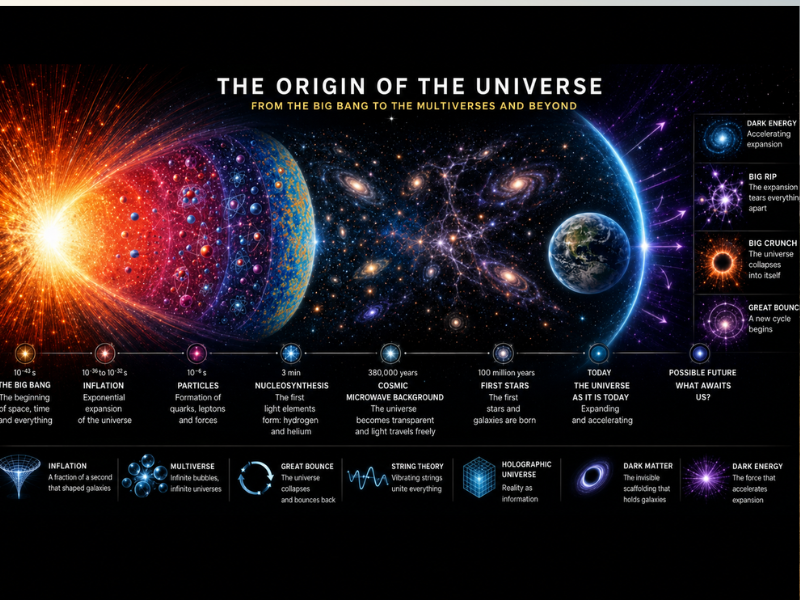
The images in this post were generated for illustrative purposes with AI assistance
Summary of Theories on the Origin of the Universe
| Theory | Key Concept | How did it begin? | What does it say about the future? | Level of acceptance |
|---|---|---|---|---|
| Big Bang | Expansion from a dense point. | 13.8 billion years ago in a singularity. | The universe cools and expands. | Highest / Standard Model. |
| Inflationary Theory | Ultra-fast initial expansion. | An exponential “stretch” during the first second. | It explains the flatness of the cosmos. | Very high / Complements the Big Bang. |
| Steady State Theory | Eternal and unchanging universe. | It has no beginning; it has always existed. | It always remains the same. | Low / Almost discarded. |
| Big Bounce | Eternal cycle of expansion. | It is the rebound of a previous universe that collapsed. | A new collapse and a new bounce. | Moderate / Loop quantum gravity. |
| Multiverse | Infinite bubble universes. | Our Big Bang is only one among many. | It depends on each universe. | Theoretical / Growing. |
| String Theory | Vibration of energy strings. | Collision of “branes” in extra dimensions. | A brane collision or dissolution. | Theoretical / Advanced physics. |
| Holographic Theory | Projection of information. | Quantum information encoded on a boundary. | Evolution of quantum data. | Theoretical / Experimental. |
1. The Big Bang: Much More Than Just a Simple Initial Explosion
The Big Bang theory is the cosmological model most accepted by the international scientific community as the origin of the universe, but it is often explained in such a simplistic way that it loses all its essence. It wasn’t an explosion of matter in empty space, like fireworks in the middle of the night.
It was the expansion of space itself from the inside out. To properly understand this, we have to go back to the late 1920s. That was when a Belgian physicist and priest named Georges Lemaître proposed the idea that the universe began as a primordial atom.
Lemaître was a visionary who realized that if the universe was expanding according to Einstein’s equations, then it must have had a starting point. Shortly after, the astronomer Edwin Hubble confirmed this with his observations at the Mount Wilson Observatory.
Hubble noticed that the light from distant galaxies was stretching toward the red. This indicated that they were moving away from us at incredible speeds. It was the first big wake-up call for modern cosmology. From then on, the idea of a static and eternal universe collapsed forever.
The first moments and the creation of matter
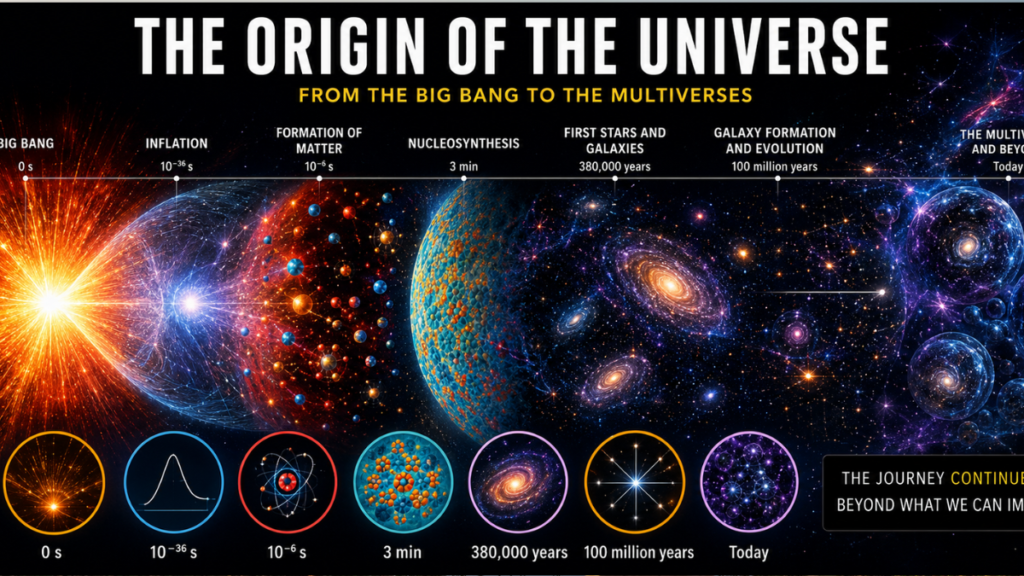
If we really want to expand on this topic, we have to talk about what happened in the first fractions of a second after time zero. Scientists divide this stage into several fascinating eras.
First, we have the era of grand unification, where all the forces of nature were blended into one. It was a state of energy so pure and dense that atoms didn’t even exist yet. The temperature was in the trillions of degrees, and everything was a chaotic plasma. As the universe expanded, it cooled down slightly, and this allowed the force of gravity to separate from the other fundamental forces, like electromagnetism.
This cooling was the key to everything that came after. When the universe was just a millionth of a second old, the first quarks and gluons formed. These are the smallest particles we know of, and they are the building blocks of protons and neutrons.
Imagine the density at that moment. It was like trying to compress all the mass of the Earth into a matchbox. The struggle between matter and antimatter also happened at this instant. For some reason we still don’t fully understand, there was a tiny excess of matter over antimatter. That tiny difference is what allowed the universe not to destroy itself and for solid things like us to exist today.
Primordial nucleosynthesis and the cosmic background
About three minutes after the beginning, what we call primordial nucleosynthesis started. The temperature dropped enough for atomic nuclei to stick together. That’s when hydrogen and helium formed in the proportions that we still detect today in the oldest stars.
It’s mind-blowing to think that most of the atoms making up the water you drink today were made in those first minutes of the universe’s life. The accuracy of the calculations for this stage is one of modern physics’ greatest achievements because it matches exactly what we see through telescopes.
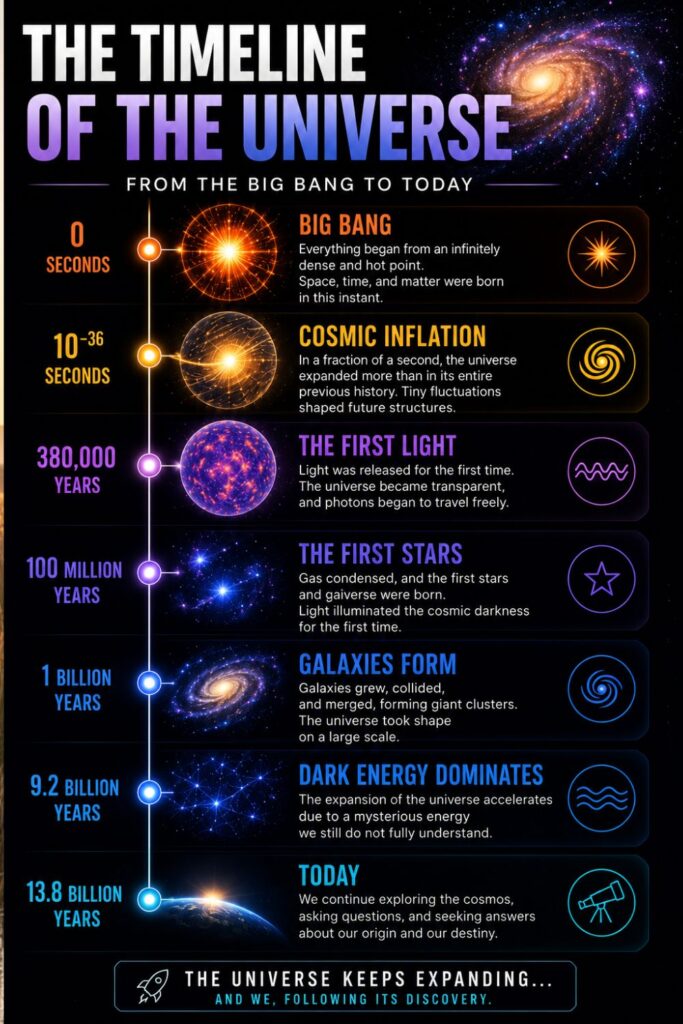
However, light couldn’t travel freely until much later. For the first three hundred eighty thousand years, the universe was like a thick fog of charged particles that trapped photons. When the universe cooled down enough, electrons combined with nuclei and space suddenly became transparent.
That first light emitted is what we now know as the cosmic microwave background. It’s the oldest fossil we have from the origin of time. It was accidentally discovered by two radio engineers who were looking for interference and ended up finding the echo of the universe’s birth. This discovery earned them the Nobel Prize and provided one of the strongest pieces of evidence in favor of the Big Bang model.
2. Inflationary Theory and the Origin of the Universe
If the Big Bang were the engine of a car, inflation would be the turbo that kicks in right at the start of the race. This theory didn’t pop up out of nowhere; it emerged to solve several mathematical puzzles that the traditional Big Bang model could not explain. The traditional Big Bang didn’t explain why, if we look to the north and south of the universe, the temperature is exactly the same.
Logically, these two regions are so far apart that light hasn’t had time to travel from one to the other to even out the heat. This is what scientists call the horizon problem. Alan Guth, a physicist at MIT, proposed in 1980 that the universe went through a violent stretch that changed everything.
The inflaton and the speed that defies logic
To expand on this concept, we need to talk about the inflaton field. It’s assumed to have been a form of energy from the vacuum itself that acted like a repulsive gravity.
Imagine space itself had built-up tension that suddenly got released. In a time trillions of times shorter than a blink, the universe multiplied its size by a factor of ten to the twenty-sixth. It’s a number that’s beyond human imagination.
What this process did was stretch out all the wrinkles and curves of the initial space. That’s why today, when we measure the geometry of the universe, it comes out flat. It’s like stretching a sheet so much that all the folds disappear.
The most fascinating thing about inflation is that it gives us the answer to the origin of cosmic structures. In the microscopic world, everything vibrates due to quantum uncertainty. Normally, these vibrations are tiny and disappear, but inflation was so fast that it froze them and made them macroscopic.
Those stretched vibrations created areas with just a bit more density than others. Billions of years later, those denser areas attracted more matter through gravity and formed galaxies. Without inflation, the universe today would be a perfectly uniform gas cloud where stars could never have formed. We are, literally, the echo of quantum vibrations that became gigantic eons ago.
3. The Steady State Theory: The Struggle for Eternity
Although today it may seem like a relic from the past, it’s essential to understand why minds like Fred Hoyle clung to it so strongly. This theory argued that the universe is perfect and that it didn’t have to have a traumatic beginning.
For supporters of this idea, the Big Bang was an almost mystical or religious proposal that didn’t fit with their vision of an eternal, unchanging cosmos. The main postulate was the Perfect Cosmological Principle, which says that the universe looks the same from any point and at any time in history.
The continuous creation of matter in the vacuum
For the universe to expand and at the same time always look the same, Hoyle had to introduce a revolutionary idea: continuous creation. According to him, matter wasn’t all created at once in the beginning, but is gradually created in the gaps left by the expansion. He calculated that it only needed one hydrogen atom to appear per liter of space every billion years for the numbers to work out. It was an elegant idea because it eliminated the need to explain what happened at time zero. However, this theory started to fall apart when we discovered quasars.
By observing these very distant objects, astronomers realized that they only existed in the distant past and that there are no quasars near us. This proved that the universe has changed over time and that it is not the same now as it was ten billion years ago. This was a fatal blow to the Steady State theory, but it left us an incredible legacy. Fred Hoyle, trying to prove his theory, discovered how stars make carbon and oxygen inside them.
Although his cosmology failed, his work on the origin of chemical elements is the reason we now understand that we are made of stardust. It’s a perfect example of how a scientific mistake can lead to a historic discovery.
4. The Big Bounce: The Eternal Return of Matter
Here we enter one of the most modern frontiers of theoretical physics. The Big Bounce is one of the strongest alternatives for those who don’t accept that the universe came from absolute nothingness.
This theory is based on loop quantum gravity, which is a way to try to reconcile Einstein with quantum mechanics. Einstein’s problem is that his equations say that at the start of the Big Bang, the density was infinite, and the word infinite sounds like a mistake to physicists. The Big Bounce proposes that there’s a physical limit to how small something can be.
The quantum network of space and time
According to this view, space isn’t an empty stage where things happen, but is made up of a network of energy loops. Imagine space like a knit fabric. If you try to squeeze that fabric too much, there comes a point where the threads can’t be compressed any further and start pushing outward.
When the previous universe collapsed under its own gravity, it reached a point of critical density and, instead of disappearing into nothingness, it experienced a quantum push that flung it outward again. It’s like the universe is a rubber ball bouncing off the floor of quantum physics.
This presents us with a scenario of oscillating universes. Maybe we live in an infinite cycle where the universe expands and contracts forever. What seems most incredible to me about this theory is that it suggests we could find traces of the previous universe.
Some researchers analyze the cosmic microwave background looking for anomalous spots that could be the scars of colossal black holes that existed before our own Big Bang. If this were confirmed, it would change our perception of time forever, shifting from a line with a beginning and an end to an eternal circle of creation and destruction.
5. The Multiverse: The Possibility of Infinite Parallel Realities
When we talk about the multiverse, we’re not just daydreaming about movie plotlines. In modern cosmology, the idea that our universe isn’t the only one comes up as a logical consequence of eternal inflation. If we accept that the process that made our space grow exponentially happened once, there’s no physical reason to think it’s not happening elsewhere in the mega-cosmos constantly.
It’s like space-time is an ocean of energy that’s boiling, and each bubble that rises to the surface is a universe with its own Big Bang and its own set of rules.
The eternal inflation and the bubbles of existence
Andrei Linde, one of the fathers of this idea, suggests that inflation never stops on a global level. While we’re here living our lives, in incredibly distant regions, space keeps expanding at absurd speeds.
Every now and then, a small region stabilizes, inflation slows down, and the accumulated energy turns into matter, creating a new universe. This means the cosmos could be an infinite fractal of universes being born within each other. The most striking thing is that each of these universes could have different physical constants. In some, the force that holds atomic nuclei together could be so weak that chemical elements would never form, leaving a universe empty of stars and life.
But there’s a type of multiverse that unsettles me even more, and it’s the one that comes from quantum mechanics. The many-worlds interpretation suggests that reality splits with every decision or subatomic event.
If this is true, there’s an infinite number of versions of reality where every possibility has played out. There’s a version of history where the dinosaurs never went extinct or where you decided to study something completely different. Although it sounds crazy, mathematically it’s one of the cleanest explanations for understanding how the very small world behaves. The idea that we’re just a speck of dust in an infinite archive of realities is, at the very least, humbling and fascinating at the same time.
6. String Theory: The Symphony Connecting the Very Big and the Very Small
Surely you’ve heard that physics has a communication problem. Einstein’s relativity wonderfully explains how galaxies move, but it fails when we try to apply it to atoms.
On the other hand, quantum mechanics is perfect for particles but ignores gravity. String Theory was born with the ambition of being the theory of everything, the master formula that solves this conflict once and for all. Its proposal is so elegant that it looks like art: it tells us that if we could look through an infinitely powerful microscope, we would see that particles are not points, but tiny strings of energy that vibrate.
The hidden dimensions that we can’t perceive
For this symphony to work, mathematics requires that the universe have many more dimensions than we see. We move in three dimensions of space and one of time, but String Theory needs ten or eleven dimensions for the pieces to fit together.
Where are those extra dimensions? The explanation is that they are compacted or rolled up on themselves at scales so tiny that they are impossible to detect. Imagine a garden hose seen from far away. It looks like a one-dimensional line. But if you get closer, you see it has a circumference, a second dimension that is only evident up close. The same would happen with space-time.
This theory also talks to us about branes, which are like membranes of higher dimensions. Some physicists propose brane cosmology, where our entire universe is a sheet floating in a space of higher dimensions.
According to this view, the Big Bang could have been the result of the collision between two of these huge branes. The impact released such a massive amount of energy that it led to the creation of all the matter we know. It’s a way of looking at the origin that doesn’t require everything to come from nothing, but instead places us as part of a dimensional structure much more complex and deep than we ever imagined.
7. The Holographic Universe: Information as the Basis of Reality
This is, without a doubt, the theory that most shakes up our everyday perception. The holographic principle suggests that the third dimension we experience, with all its depth and volume, is actually a projection of information stored on a two-dimensional surface.
I know it sounds like bad science fiction, but this idea came from studying black holes, the most extreme places in the universe. Stephen Hawking and other geniuses realized that when something falls into a black hole, its information doesn’t disappear; instead, it seems to get recorded on the surface of the black hole, as if it were the cover of a book containing the entire story of its interior.
Are we just a projection of quantum data?
If we take this concept to the scale of the entire universe, the conclusion is astonishing. Everything we see, feel, and touch could be a projection of data that exists at the outer boundary of the cosmos. It’s very similar to how a security hologram on a credit card works or how a two-dimensional movie projects a sense of depth on a screen.
In this model, gravity and space-time wouldn’t be basic elements of nature, but rather emergent effects of something more fundamental: the quantum entanglement of information.
This vision is changing the way scientists approach cutting-edge physics. If the universe is a hologram, then reality is, at its core, pure information being processed. This leads us to almost philosophical questions about whether we live in some kind of natural simulation, or if matter is just a secondary form of data.
What’s clear is that our intuition about what is solid and what is real is very far from what the most advanced mathematics is starting to suggest about the true structure of everything.
8. Dark Matter: The Invisible Glue That Holds Galaxies Together
When we talk about the origin of the universe, we usually focus on what shines, but the truth is that we are an absolute minority. Everything we know, from the cells in your body to the Sun, is made of baryonic matter, which barely represents five percent of the total cosmos.
The rest is a deep mystery. Dark matter is the silent protagonist of this story. We can’t see it because it doesn’t emit, reflect, or absorb light, which makes it invisible to all our telescopes, from radio ones to X-ray ones. We know it’s there purely through detective-like deduction: we see how its gravity pulls on the stars.
The scaffolding on which the world was built
Vera Rubin, a tenacious astronomer, realized in the seventies that galaxies were rotating in an impossible way. The stars on the outer edges were moving as fast as those in the center, something that defies Newton’s laws if we only consider visible matter.
They should be flung out like drops of water from an umbrella that spins too fast. What keeps them together is a gigantic halo of dark matter that surrounds each galaxy. But its importance goes far beyond just keeping galaxies together today.
Without dark matter, we wouldn’t exist. In the early universe, right after the Big Bang, normal matter was too hot and chaotic to clump together. It was dark matter, which isn’t affected by light or heat in the same way, that started forming clumps first.
These clumps created gravitational wells that pulled in hydrogen gas, allowing the first stars and galaxies to form. It’s literally the invisible scaffolding on which the cement of ordinary matter was poured. We still don’t know exactly what it is—whether it’s particles called WIMPs or something more exotic like axions—but without this glue, the universe would be an empty, structureless place.
9. Dark Energy: The Force That Pushes the Void
If dark matter is the glue that tries to hold things together, dark energy is the mysterious force that tries to pull them apart. The worst part is that it’s winning the battle. For a long time, we thought the expansion of the universe would slow down because of gravity, just like a ball you throw in the air eventually falls. But in 1998, two teams of astronomers studying distant supernovas discovered something that left science in shock: the universe is not only expanding, but it’s doing so faster and faster.
The cosmological constant and the fate of the expansion
This acceleration is attributed to dark energy, which makes up no less than sixty-eight percent of the universe. It’s as if the very vacuum had an intrinsic energy that pushes space outward.
Einstein had already included something similar in his equations, the cosmological constant, although he later regretted it and called it his biggest mistake. Turns out he was right. As more space is created between galaxies, there is more dark energy, which accelerates expansion even further. It’s a cycle that doesn’t seem to end.
Understanding dark energy is the biggest challenge in twenty-first-century physics. If it’s a constant property of space, the universe will keep expanding forever. If, on the other hand, its strength changes over time, the consequences could be catastrophic.
This energy is what decides the final script of our story. We’re trapped in a struggle of forces between gravity, which wants to pull everything into a single point, and this invisible energy that wants to stretch reality until it breaks. For now, the balance is tipping toward total cosmic isolation in the distant future.
The End of Everything: The Scenarios of the Cosmic Apocalypse
Knowing how the universe began gives us the tools to predict how it will end. Even though we’re talking about times beyond human comprehension, physics allows us to outline three main paths. Each of them depends on the total amount of matter and energy in the cosmos and on how that dark energy we just talked about behaves.
From the Big Freeze to the Big Rip: How will the light go out?
The most widely accepted scenario right now is the Big Freeze or Heat Death. In this future, the expansion keeps going indefinitely. Galaxies will move so far away that we would stop seeing them from Earth, getting trapped on an island of darkness. Stars will run out of fuel, white dwarfs will cool down, and black holes will evaporate after trillions of years due to Hawking radiation.
The universe will become an immense, cold, and empty place where entropy has reached its maximum and no physical processes can happen anymore. It’s a silent and eternal ending.
However, there are more violent alternatives. The Big Rip would happen if dark energy keeps getting denser and stronger. There would come a point when the expansion would be so fierce that it would overcome gravity on all scales. First, galaxy clusters would break apart, then solar systems, and finally, even atoms would be ripped apart.
Lastly, there’s the Big Crunch, where gravity ends up winning over expansion and the universe starts to shrink until it collapses back into a singularity, closing the cycle and maybe giving rise to a new Big Bang.
Whatever the ending, understanding these theories makes us appreciate how incredibly special this moment in history is, where there is still light, warmth, and life.
Frequently Asked Questions About the Origin of the Universe
What was there exactly before the Big Bang happened?
According to the most traditional view, time and space were born at that moment, so there is no ‘before.’ It’s like asking what’s north of the North Pole. However, theories like the Big Bounce suggest that we came from the collapse of a previous universe, and string theory proposes that our universe could have been born from the collision of dimensional sheets called branes. It’s one of the questions that still divides the world’s top scientists.
Is the universe something infinite or does it have some kind of physical limit that we can’t see?
We don’t know for sure. The observable universe is finite because light has only had a limited amount of time to reach us. But the entire universe could be infinite. If it has a flat geometry, it could go on forever. If it’s curved, it could be like the surface of a sphere: finite in size but without an edge where you could fall off. Most of the current data suggests it’s amazingly flat.
Where exactly is the center of the universe right now?
There is no center. The Big Bang wasn’t an explosion from a point into empty space; it was space itself that was created everywhere at once. Any place in the universe is the center of its own observable universe. If you were in a galaxy a billion light-years away from here, you would see all the galaxies moving away from you just the way we see them from Earth.
Could we somehow travel to the origin of time?
Physically, it’s impossible to travel to the past to witness the beginning, but astronomy is basically a time machine. Because light has a finite speed, when we look at very distant galaxies, we’re seeing them as they were billions of years ago. Telescopes like the James Webb are right now capturing light that came from the very first stars almost at the start of everything, letting us see the past directly.
What relationship exists between these scientific theories and human spirituality?
Science looks for the how, and spirituality looks for the why. For many scientists, discovering the complexity and harmony of physical laws is a deeply spiritual experience. Knowing that the atoms in our bodies were forged in the hearts of exploding stars gives us a material and real connection to the cosmos. They are two different languages trying to make sense of the amazing reality of our existence.
I loved sharing all this knowledge with you. The origin of the universe is the greatest mystery we have, and I hope you now see it with much more clarity and excitement. Which of all these theories made you think the most? Can you imagine a different ending for our story? I would love to read your thoughts in the comments and keep chatting about this endless journey. Talk to you soon!