
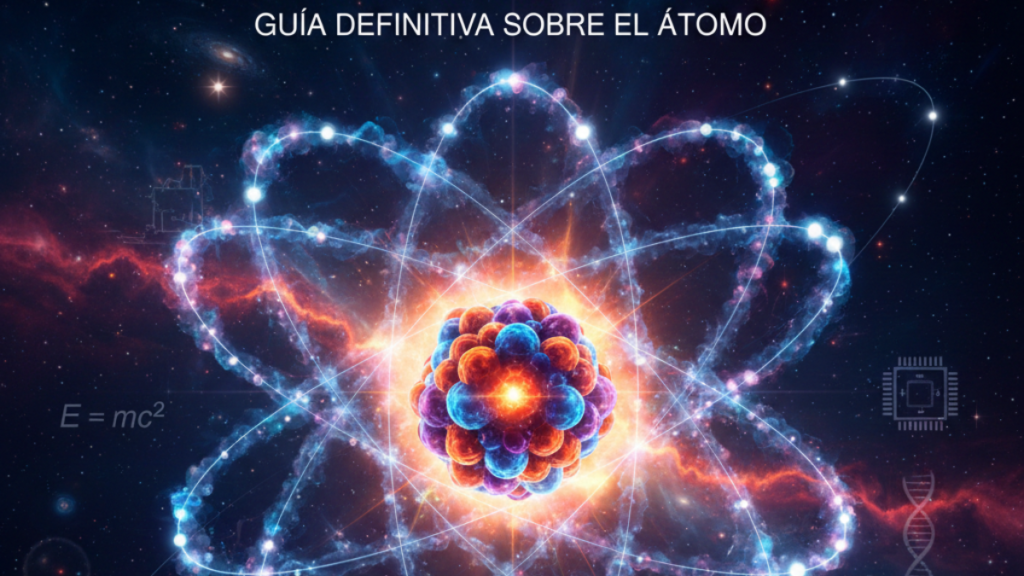
Have you ever wondered what you’re really made of? Discover the most comprehensive and fascinating guide to the atom. We’ll take you on a journey from ancient Greece to modern quantum physics. Dive in and prepare to be amazed!
Sometimes, I stop to look at my hands or the coffee cup in front of me, and it blows my mind when I think about this: 99.99% of everything we see is, technically, empty space. Yes, you read that right. If we removed the empty space from all the atoms of every human being on the planet, all of humanity would fit inside a sugar cube! But of course, that sugar cube would weigh billions of tons.
Isn’t that amazing? That’s the energy and power of the atom. I’m passionate about this topic because understanding the atom is, quite literally, understanding the rules of the game of reality. It’s not just science; it’s our deepest story.
The Origin of an Idea: From Philosophy to Reality
It all started with a man with a vivid imagination named Democritus, back in ancient Greece. He wondered: if I cut an apple in half, and then again, and again… will there come a point where I can’t cut it any further? He called that indivisible piece an “atom,” which means “indivisible.”
For centuries, this idea was just a philosophical curiosity. No one could see it, no one could prove it. But human curiosity is unstoppable. We went from thinking that everything was earth, air, fire, and water, to understanding that there are universal building blocks.
Dalton’s Revolution: The First Serious Step
It was John Dalton, back in the 19th century, who revived the idea. He imagined atoms as small, solid billiard balls, each one different for every element. Although we now know he was wrong about them being “solid,” Dalton gave us the foundation for understanding that chemistry is not magic, but rather the exact proportions of these building blocks.
Thomson’s Plum Pudding Model and the Discovery of the Electron
In the late 1800s, things got interesting. J.J. Thomson discovered that the atom wasn’t indivisible. It had something inside it! He found tiny negatively charged particles: electrons. He pictured the atom as a sponge cake (the positive charge) filled with raisins (the electrons).
It was a major breakthrough, but we were still far from the truth. Someone still needed to come along and “bombard” the atom to see what happened.
The Experiment That Changed Everything: Rutherford and the Nucleus
Ernest Rutherford did something amazing. He fired particles at a wafer-thin sheet of gold. He expected them all to pass right through, but some… bounced right back! It was like firing a bullet at a tissue and having the bullet come right back at you.
That’s when we realized that the atom has a small, dense, positively charged core: the nucleus.
The Anatomy of an Invisible Giant: What Is an Atom Made Of?
Let’s take a closer look. If we could zoom in infinitely, what would we see today? Forget about billiard balls. An atom is a dynamic, vibrant system brimming with energy.
1. The Core: The Heart of the Matter
At the very center lies the nucleus. It is ridiculously small compared to the atom’s total size, but it contains almost all of its mass. Two key players reside here:
- Protons: They have a positive charge. They’re the ones that determine “who’s who.” The number of protons defines the element. If you have one proton, you’re hydrogen. If you have six, you’re carbon. It’s matter’s ID.
- Neutrons: they’re like peacemakers. They have no charge (they’re neutral), but they help prevent protons from repelling each other because they have the same charge. They’re the glue that provides stability.
2. The Electron Shell
Surrounding the nucleus, in a frantic dance, are the electrons. They have a negative charge and weigh almost nothing. But don’t picture them as planets orbiting the sun in an orderly fashion. The reality is much crazier: they exist in a sort of “probability cloud.”
We don’t know exactly where they are at any given moment; we only know where we’re most likely to find them. This region is what determines how one atom bonds with another. It’s what makes water water and allows you to touch your phone screen right now.
The Fundamental Forces: The Glue That Holds the Universe Together
Why doesn’t the atom fall apart? Why don’t the electrons fly off? This is where the forces of nature come into play, and I promise you, it’s fascinating.
The strong nuclear force
Imagine trying to bring two magnets together with their like poles facing each other. They repel each other, right? Well, since all the protons in the nucleus are positively charged, they should fly apart. But they don’t, thanks to the strong nuclear force. It’s the most powerful force in the known universe, but it only acts over incredibly short distances. It’s the cosmos’s strongest embrace.
The electromagnetic force
This is what keeps the electrons “bound” to the nucleus. Since the electrons are negative and the nucleus is positive, they attract each other. It is a perfect balance between the electron’s desire to escape and the nucleus’s pull.
Quantum Dance: From Bohr’s Orbits to Total Uncertainty
After Rutherford discovered the nucleus, a huge problem arose. According to the laws of physics at the time, if an electron (negatively charged) orbited a nucleus (positively charged), it should lose energy and eventually crash into the center. All matter should collapse in a matter of seconds! But here we are, alive and well. What was going on?
Niels Bohr’s Model: Energy Levels
This is where Niels Bohr comes in, in 1913. He proposed something that seems obvious to us today, but which was revolutionary at the time: electrons cannot be just anywhere. They move in specific energy levels, as if they were the rungs of a ladder.
If an electron is on a rung, it is stable. To move up a rung, it needs a “boost” of energy (such as light or heat). When it moves down a rung, it releases that energy in the form of a flash of light called a photon. That’s why fireworks have colors: we’re seeing electrons from different atoms jumping from rung to rung. It’s pure atomic choreography!
Schrödinger and the Cat: Welcome to the Probability Cloud
But science doesn’t stand still. Guys like Erwin Schrödinger and Werner Heisenberg came along and said, “Bohr, your model is nice, but reality is much more chaotic.”
They discovered that the electron isn’t just a particle—it also behaves like a wave! Forget about orbits like those of planets. In the current model, we talk about orbitals. An orbital isn’t a path, but a region of space where there’s a very high probability of finding the electron.
It’s like trying to find a hyperactive child at a playground: you don’t know exactly where they are at any given moment, but you know they’re usually near the swings. That “swing area” is the orbital. This is the basis of quantum mechanics, and although it may seem crazy, it’s what makes lasers, the transistors in your computer, and MRI machines in hospitals work.
The Periodic Table of Elements: Why Is Gold Gold and Oxygen Oxygen?
This is one of the questions that fascinated me most as a child. If all atoms have protons, neutrons, and electrons… why do some form the gas we breathe, while others form a shiny, expensive metal?
The answer is simple and elegant: it’s all about quantity.
The Atomic Number: The Soul of the Element
The number of protons in the nucleus is what defines an atom’s identity. It’s its unique serial number.
- If an atom has just 1 proton, it’s hydrogen. The fuel of the stars.
- If it has 8, it’s oxygen. What keeps us alive.
- If it has 79, it’s gold.
If through some physical process you could add or remove protons from an atom (something that happens in stars or in nuclear reactors), you would literally be transforming matter. The dream of the ancient alchemists brought to life by physics!
Atomic Mass: The Weight of the Invisible
The mass of the atom is basically the sum of its protons and neutrons. Electrons are so light that we don’t even count them for the weight, as if you weighed yourself and didn’t count whether you have a hair more or less on your head.
Isotopes: Siblings with different weights
Here comes a key concept that sometimes confuses people. Imagine two carbon atoms. Both have 6 protons (otherwise, they wouldn’t be carbon). But one has 6 neutrons and the other has 8. These “siblings” are called isotopes.
The carbon with 8 neutrons (Carbon-14) is famous because it’s unstable and decays over time, which allows humans to figure out how old a dinosaur bone or an ancient mummy is. The atom, besides being a builder, is the best historian in the world!
The Periodic Table: The Treasure Map of Matter
I can’t talk about the atom without mentioning Dmitri Mendeleev. He was the genius who realized that if we arranged the elements by their number of protons and how their electrons behave, a pattern emerged.
The periodic table isn’t just a list; it’s a map of relationships. Elements in the same column behave the same way because they have the same number of electrons in their outermost shell (the valence shell). Those outer electrons are like the atom’s ‘hands’: they’re what it uses to grab onto other atoms.
- The noble gases (all the way on the right) have their “hands” full and are very independent: they don’t usually react with anyone.
- The alkali metals (on the left, like sodium) have a “free hand” and are desperate to grab onto someone, that’s why they are so reactive.
Ions: Atoms with Spark
Normally, an atom is neutral: it has the same number of protons (+) as electrons (-). The charges cancel out and everything is peaceful. But sometimes, an atom loses or gains electrons.
- If it loses an electron, it ends up with more positive charge: it’s a cation.
- If it gains an electron, it becomes negative: it’s an anion.
These ‘electric’ atoms are called ions, and thanks to them your neurons can send signals right now, so you can understand what you’re reading. Without the movement of sodium and potassium ions in your body, you simply wouldn’t be able to think or move a finger.
Atomic Energy: The Giant That Slept in the Core
If you’ve ever seen Einstein’s famous equation, E = mc^2, this is where it comes to life. That formula tells us that a tiny amount of mass can turn into a monstrous amount of energy. And the place where that “treasure” is kept is, precisely, the nucleus of the atom.
There are two main ways to release that power, and they’re completely opposite processes: fission and fusion.
1. Nuclear Fission: Break to Release
Fission is what happens in today’s nuclear power plants. Imagine a very large and heavy nucleus, like Uranium-235. It’s an unstable nucleus, it’s ‘uncomfortable.’ If we hit it with a neutron, it splits in two.
When it breaks, not only are smaller fragments released, but an impressive amount of heat and more neutrons are released that will go on to hit other nearby atoms. This is what we call a chain reaction. If we control it (like in a power plant), we have electricity for millions of homes without emitting CO2. If it’s not controlled… well, we already know what happens in an atomic bomb.
2. Nuclear Fusion: Joining to Shine
This is my favorite because it’s literally what makes the Sun shine. Instead of breaking big atoms, we join very small atoms (like hydrogen) to form a bigger one (Helium).
For this to happen, you need brutal pressure and temperature, because the nuclei don’t want to be together (remember that protons repel each other). But when they do manage to, the energy they release is much greater than that of fission and, on top of that, it produces far less long-lived radioactive waste than fission! We’re trying to replicate this on Earth with projects like ITER, and if we succeed, we’ll have a powerful source of low-carbon energy. Fingers crossed!
Radioactivity: The Atom That Falls Apart
Surely you’ve heard the word “radioactive” and felt a bit of awe. That’s normal. But radioactivity is a natural phenomenon. Some atoms are naturally “eager”; their nucleus has a precarious balance between protons and neutrons.
To reach stability, these atoms emit particles or energy. That’s what we call radioactive decay.
- Alpha Particles: they are helium nuclei, heavy and slow. A sheet of paper can stop them.
- Beta Particles: fast electrons. You need an aluminum sheet to block them.
- Gamma Rays: it’s pure energy, like light but much more powerful. They can go through almost anything, except thick blocks of lead or concrete.
The funny thing is that you’re a bit radioactive. Yes, you have Carbon-14 and Potassium-40 in your body. We’re part of this cosmic energy dance!
From Atoms to Molecules: The Art of Connection
A single atom is like a lonely LEGO piece on the floor. It’s interesting, but not very useful. The real magic happens when atoms decide to join together to form molecules.
How do they do it? It all comes down to the electrons in their outer shell. Atoms want to be stable, and for most, stability means having 8 electrons in their last shell (the famous Octet Rule).
The Covalent Bond: Sharing Is Caring
Imagine two hydrogen atoms. Each one has one electron, but they want two to be happy. What do they do? They get so close that they share their electrons. That electronic ‘glue’ is a covalent bond. It’s the bond that forms water (H_2O), or the oxygen you breathe (O_2).
The Ionic Bond: The Necessary Theft
Sometimes, one atom is much stronger than another. Chlorine, for example, is an ‘electron thief,’ and Sodium doesn’t mind ‘giving away’ the only one it has left. When Sodium gives its electron to chlorine, one becomes positive and the other negative. Since opposites attract, they stick together with incredible force. The result? The table salt you put on your fries.
The Atom in Your Everyday Life (Even If You Don’t See It)
By this point, you might be thinking, ‘Okay, this is very theoretical.’ But let me tell you that the atom is the star of your routine:
- Your smartphone: Chips work thanks to the movement of electrons in semiconductor materials like silicon. Without atomic physics, you’d be using smoke signals.
- Medicine: When you get an X-ray or a PET scan to detect a disease, we’re using the radioactivity of atoms to ‘look’ inside you without opening you up.
- LED light: Those diodes that light up your house work by making electrons jump between different energy levels in a semiconductor material, releasing light photons.
Frequently Asked Questions (FAQ) about the Atom
Can you see an atom?
Not with visible light (like the kind our eyes see), because atoms are smaller than the wavelength of light. But we have tunneling microscopes that can “sense” them and create maps of their surface. We already have pictures of groups of atoms!
Is the atom dangerous?
The atom itself isn’t bad. It’s like a hammer: it can be used to build a house or to cause harm. Science gives us the tool, we decide how to use it.
What color is an atom?
They don’t have color. Color is a property of how light bounces off large groups of atoms. A single atom is too small to have ‘color’.
Are atoms eternal?
Almost. Some isotopes decay quickly, but the stable atoms in your body could have been in a star that exploded billions of years ago. We are, literally, stardust.
Did you know that 90% of the atoms in your body are renewed every year? We are not the ‘matter’ we are made of, but the ‘pattern’ in which those atoms are organized.
Beyond the Core: The Zoo of Elementary Particles
For a long time, we thought that protons and neutrons were solid little balls. But in the 1960s, scientists began to suspect there was something more. Thanks to particle accelerators (those giant tunnels where we smash atoms at nearly the speed of light), we discovered that the nucleus is much more complex.
Quarks: The ultimate building blocks
Protons and neutrons are made of even smaller particles called quarks. There are six types (or “flavors,” as physicists jokingly say), but the ones that matter for normal matter are Up and Down.
- A proton has two up quarks and one down quark.
- A neutron has two down quarks and one up quark.
The craziest thing is that you’ll never see a quark alone. They are bound by the strong nuclear force through other particles called gluons (from the English ‘glue’). It’s such a brutal bond that if you try to separate two quarks, the energy you use to stretch them automatically turns into… more quarks! It’s like trying to break a rubber band and, when it breaks, two new rubber bands appear in your hands.
The Higgs Boson: Why Do We Weigh Something?
If the atom is mostly empty, why do things have mass? Why is it hard to push a car but not a feather? In 2012, we confirmed the existence of the Higgs Boson, often called “the God particle” (though scientists aren’t too thrilled with that name).
Imagine that the universe is filled with a kind of invisible “molasses” called the Higgs Field. Some particles pass through it effortlessly and have no mass (like photons of light). Others get “stuck” and find it hard to move, and those are the ones that gain mass. Without the Higgs, atoms couldn’t form because electrons would fly off at the speed of light. We wouldn’t exist!
The Atom and the Universe: A Poetic Connection
By this point, I get a little sentimental. Every atom of Iron in your blood, every atom of Calcium in your teeth, and every atom of oxygen filling your lungs was not created here on Earth.
They were forged in the hearts of massive stars billions of years ago. When those stars ran out of fuel and exploded as supernovas, they scattered the cosmos with the elements that now make you up. As Carl Sagan said, we are star stuff that has reached such a level of complexity that it can now ask about its own origin.
Understanding the atom isn’t just studying chemistry; it’s doing cosmic archaeology. It’s understanding that we are connected to the beginning of time and the edges of space.
Where are we headed? The future of atomic research
Science doesn’t stop. Right now, thousands of brilliant minds are trying to figure out mysteries that still keep us up at night:
- Dark Matter: we know there’s something out there that holds galaxies together, but it’s not made of the atoms we know. What is it?
- Quantum Computing: we’re learning to use the weird laws of electrons to create computers millions of times faster than the current ones.
- Antimatter: we know that for every particle of matter there’s one of antimatter. If they touch, they annihilate each other, releasing pure energy. Why is the universe full of matter and there’s hardly any antimatter?
Why should you care about the atom?
Let’s be honest: you can live perfectly well without knowing what a quark is or how many electrons gold has. But when you understand the atom, the world stops being just a collection of ‘things’ and becomes a spectacle of forces, energy, and balance.
Looking at a flower, the sea, or the eyes of someone you love is no longer the same. You know that beneath that appearance there’s a frantic dance of trillions of particles attracting and repelling each other, sharing energy, and that have been there since the universe was just a whisper.
Summary for curious minds
In case you got lost at any point in this mega-post, here are the key points:
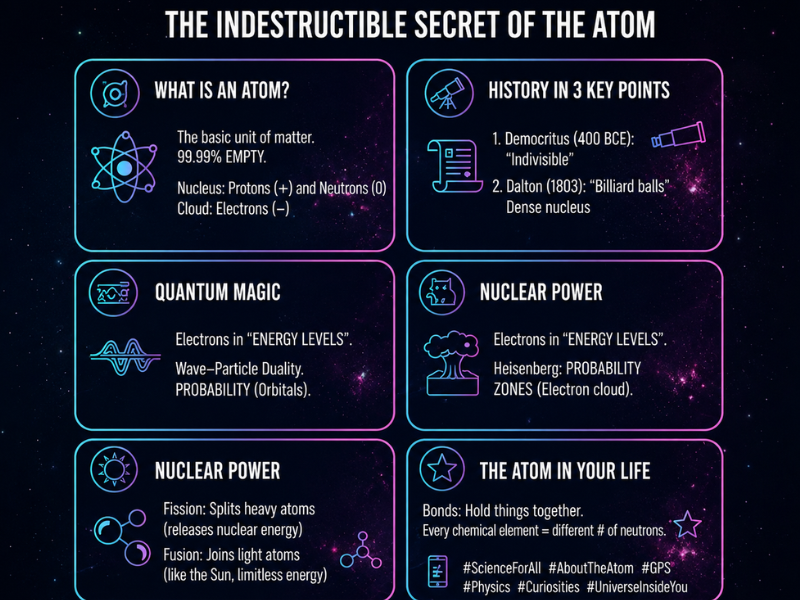
- The atom is the basic unit of matter, but it’s 99.99% empty.
- It has a central nucleus (protons and neutrons) and an outer cloud (electrons).
- What defines an element is its number of protons.
- Quantum physics tells us we can’t know exactly where the electrons are, only their probability.
- Some of the most powerful energy sources we know — including the Sun and nuclear power — come from processes in the nucleus.
- We are made of atoms forged in dead stars.
Which part surprised you the most? Did you know about empty space or quarks? Science is an ongoing conversation, and this blog wouldn’t be anything without your opinion.
Leave me a comment down below with your wildest question or just tell me what other topic you’d like us to explore in depth and without filters. I promise to read and respond!
If you liked it, share this post with that friend who loves questioning everything. Let’s make curiosity go viral!

