
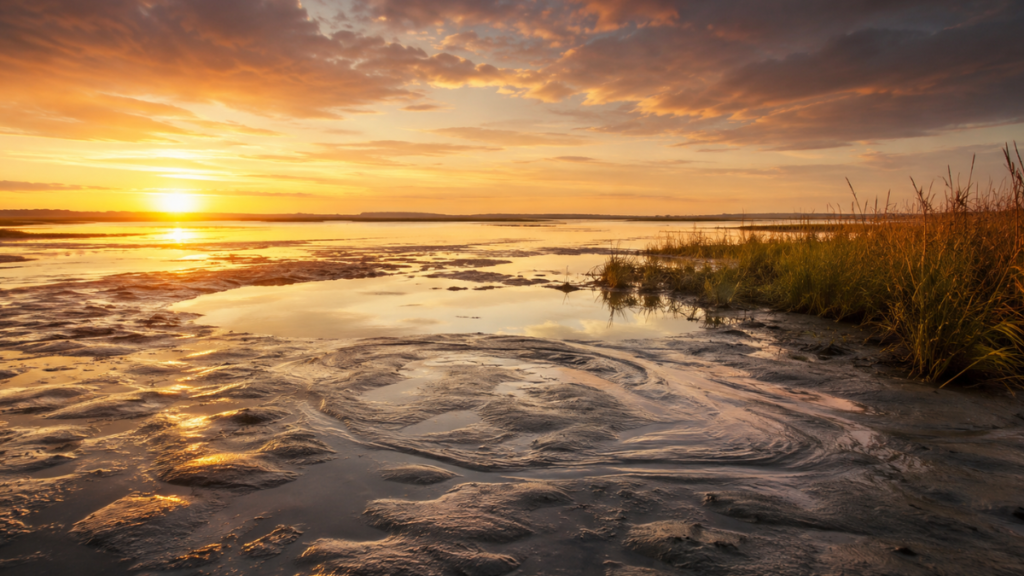
Have you ever wondered if you could really sink into quicksand like in the movies? I’m going to tell you the whole truth about this phenomenon, how to escape from it, the real science behind it, and the most absurd myths.
You’ve probably been there. You’re calmly on the couch, watching one of those adventure movies from the eighties or nineties, and suddenly, the protagonist steps where they shouldn’t.
In a matter of seconds, the ground starts swallowing them up like a hungry monster. They scream, panic, try to grab a branch that just breaks, and in the end, their best friend has to throw them a vine at the last second to save their life.
Over the years, after reading a lot about the subject and looking into it from a scientific angle, I discovered the reality. The truth is that movies have sold us a giant myth. They’re neither as dangerous as we were told, nor do they work in such a dramatic way, nor will you fall to the bottom of the Earth by stepping on a slightly soft spot.
Make yourself a coffee or an herbal tea, because we’re diving right into the mud (or rather, the sand).
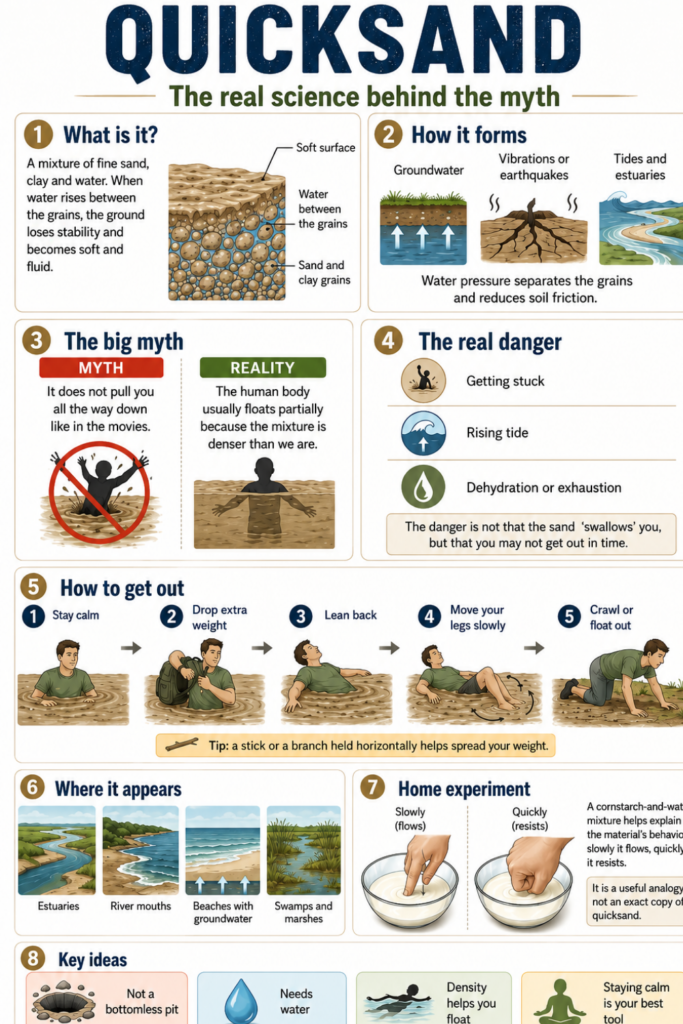
The images in this post were generated for illustrative purposes with AI assistance
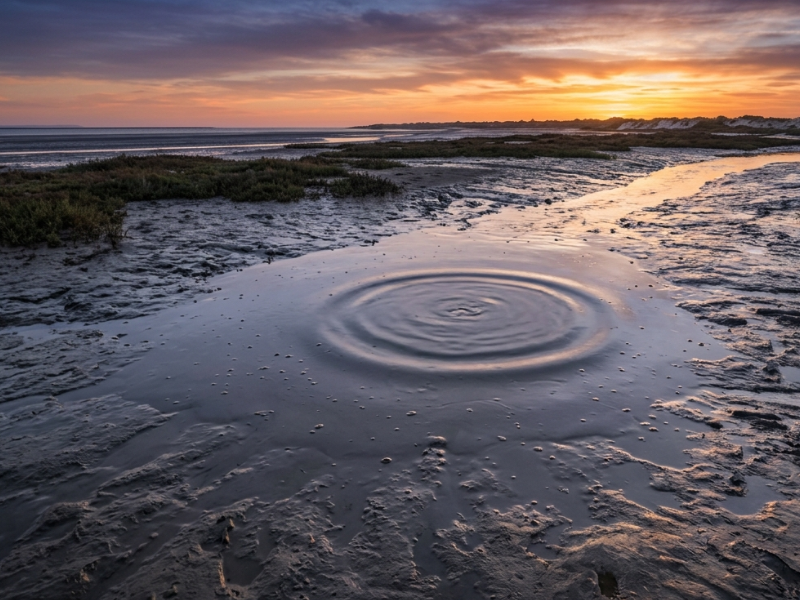
What quicksand really is and why we’ve been fooled our whole lives
When you hear the word ‘quicksand,’ the first thing that comes to mind is a bottomless pit of sand that, as if by magic, turns liquid.
Well, the first surprise is that it’s not a special type of soil. It’s not like you’re walking through the desert and there’s a ‘cursed’ sand.
Quicksand is simply a normal mixture of fine sand, clay, and water. What makes it special is the delicate balance between those ingredients.
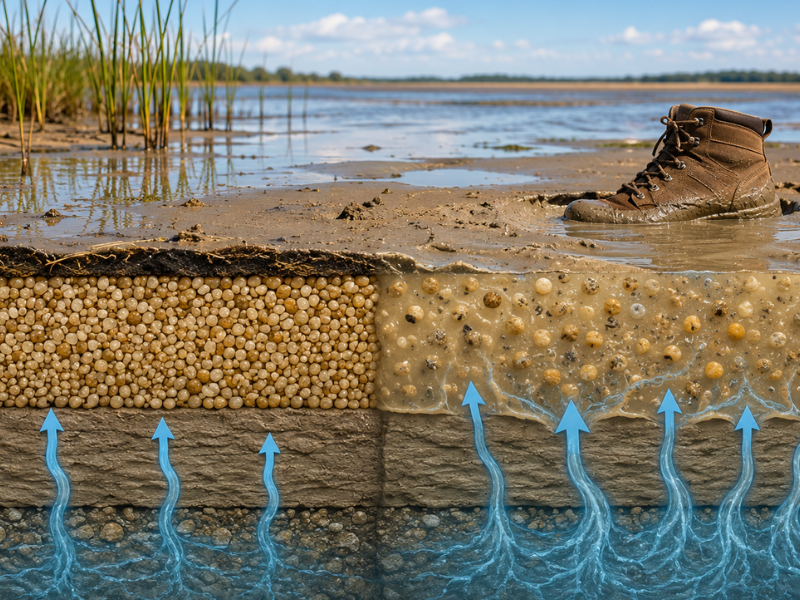
Under normal conditions, the sand grains stick together, forming a compact structure because the water between them lubricates the environment but doesn’t completely separate them. The ground seems solid, and you can walk on it perfectly.
The problem (or the scientific magic) starts when there’s an excess of groundwater or constant vibration. At that moment, the water pressure pushes the sand grains upward, separating them.
Since they’re not touching each other, the friction that kept them firm disappears. The whole ground loses its ability to support weight and temporarily turns into a kind of thick soup.
The myth of the bottomless pit
The biggest lie movies have sold us is making us believe that quicksand is an endless hole that sucks you in. This is physically impossible, and now I’ll explain why with a basic concept: density.
The human body is mostly made of water. Our average density is very similar to that of fresh water (a little less if we have air in our lungs, which is why we float in the pool).
Quicksand, being a mixture of water and a bunch of heavy minerals like quartz and clay, is much denser than us. Specifically, for the same volume, quicksand can be roughly twice as dense as the human body.
Pure physics (the old friend Archimedes and his principle of buoyancy) dictates that a less dense object can’t completely sink in a denser fluid. So, no matter what, it’s impossible for you to go all the way under.
At most, if you stay completely still and do nothing, you’ll sink up to your waist or chest. From there, your own body will float naturally.
The real danger isn’t disappearing under the sand; the real danger is getting stuck and the tide changing if you’re in a coastal area, or suffering from dehydration if you’re in full sun. But the sand itself isn’t going to swallow you.
Why movies fool us
Hollywood loves invisible dangers. You can see a cliff from afar, a bear roars before attacking, but quicksand is the perfect enemy for creating dramatic tension because it comes out of nowhere.
In the sixties and seventies, quicksand scenes became a classic trope in adventure films. It was an easy and cheap trick for the hero to show their bravery, or to get rid of a villain in a poetic way.
The problem is, we believed it. We grew up thinking the planet was full of these quicksand spots and that stepping on one was a death sentence. Today we know it’s just fiction, but the fear stuck in our collective imagination.
The science that explains everything: non-Newtonian fluids
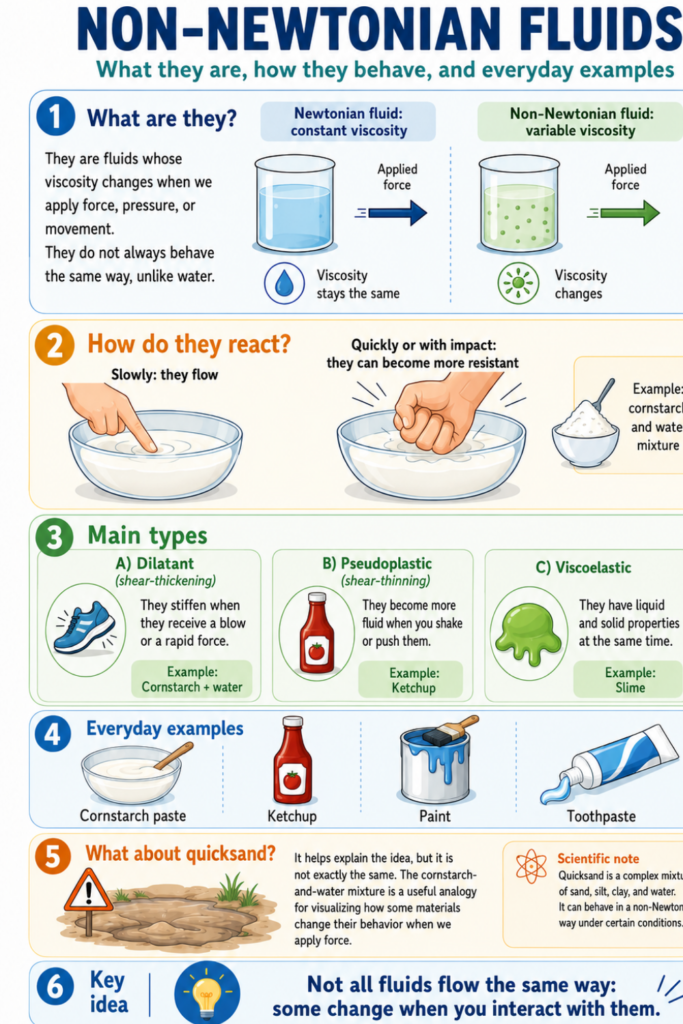
This is where things get really interesting. To understand how this terrain behaves, we have to talk about a physics concept that sounds super technical but is really easy to see in everyday life: non-Newtonian fluids.
You probably remember from school where they explained that water is a normal fluid. If you slowly put your hand into a bucket of water, the water moves aside. If you slap it in quickly, the water moves aside in exactly the same way (you just splash more). Its resistance, what scientists call “viscosity,” doesn’t change based on the force you apply. That’s a Newtonian fluid.
However, quicksand plays by different rules. It’s a non-Newtonian fluid, which means its viscosity changes depending on the force or stress applied to it.
The home experiment you can do today
To help you understand it perfectly, without having to travel to any dangerous beach, you can do a super simple experiment in your own kitchen. You just need a bowl, a cup of cornstarch (the typical Maizena), and half a cup of water.
Mix the two things with your hands until you get a thick paste. Now, try this:
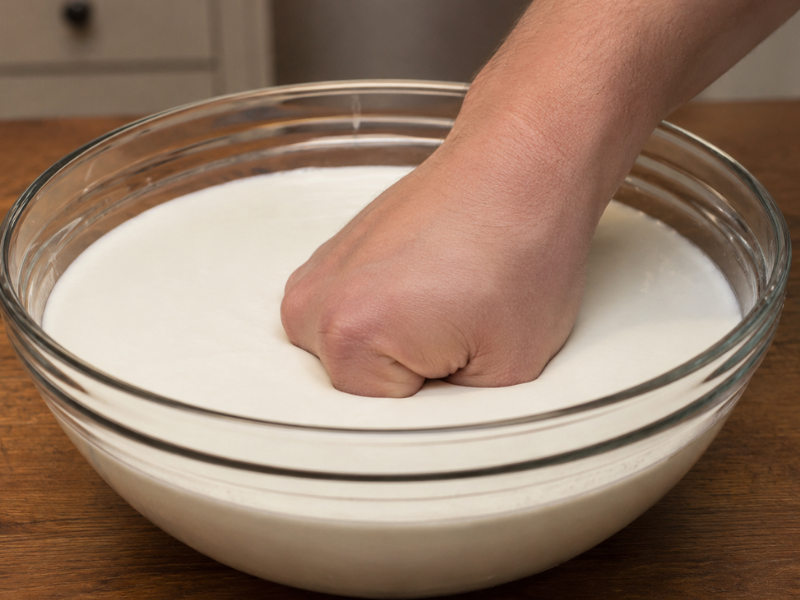
- If you slowly stick your finger into the mixture, it will go in smoothly, like custard or liquid yogurt. The mixture behaves like a liquid.
- If you try to punch the surface quickly and hard, your fist will bounce off. The mixture becomes completely solid for a moment. You can even pick up a piece with your hands, shape it like a ball as long as you keep moving it, and as soon as you open your hand and leave it alone, it will melt between your fingers like water.
It’s very similar to what happens with quicksand. When it’s calm in nature, it looks solid or like a very thick liquid.
If you walk carefully and gently, the ground supports you or lets you sink very slowly. But if you get nervous, start kicking violently and flailing your arms, the mixture reacts by becoming incredibly stiff around you. It compacts and traps you like fast-setting cement.
If you liked the experiment, don’t forget to check out the experiments section of the blog, an easy way to understand science.
The phenomenon of liquefaction
For regular sand to turn into this very special fluid, a process known in geology as soil liquefaction is needed.
Imagine you have a jar full of marbles. If you pour water in, the water will fill the gaps between the marbles. Now, if you shake the jar hard from the bottom, the marbles will separate a bit and start floating in the water.
In nature, this mainly happens due to three factors:
- Underground water currents: water that rises from beneath the ground with enough force to overcome the weight of the sand grains.
- Earthquakes: seismic waves shake the ground so violently that they separate soil particles filled with water, making entire buildings sink as if they were on jelly.
- Tidal action: in river estuaries and on beaches, the constant change in water level intermittently saturates the fine sand, creating unstable areas that change from hour to hour.
How quicksand forms and where we can find it
You don’t need to travel to the Amazon jungle or the Sahara desert to see this phenomenon. In fact, in dry deserts it’s almost impossible for them to form because they’re missing the key ingredient: liquid water. Quicksand needs constant moisture.
The perfect ingredients
For nature to cook up a good quicksand area, it needs to follow a very specific recipe:
- Very fine sand or silt: large, coarse grains settle too quickly and don’t retain water the same way. You need an almost powdered material.
- Presence of clay: clay acts as a gentle binding agent that helps keep the structure fluffy when the soil is at rest.
- Water saturation: a constant supply of water, whether from a hidden spring, a river outlet, or rain seepage.
The most common places in the real world
If you’re one of those who enjoy hiking or traveling along the coast, it’s good to know in which landscapes you’re more likely to come across this type of terrain. Not to be scared, but to go with your eyes open.
Estuaries and river mouths
It’s the classic go-to spot. When a river reaches the sea, it slows down and deposits all the fine sand and mud it carried from the mountains.
Since these areas are constantly rising and falling because of the tides, the ground never fully compacts. A very famous example in Europe is the bay of Mont Saint-Michel in France.
There, when the tide goes out, miles of sand are exposed that look solid, but hide very treacherous quicksand, combined with tides that can rise surprisingly fast.
Beaches with underground currents
Sometimes, on seemingly normal beaches, there are sources of fresh water that spring up just beneath the sand. This water pushes up from below and creates soft patches where, when you walk, you feel your foot sinking much more than usual.
Edges of lakes, swamps, and peat bogs
Around stagnant bodies of water, the buildup of decaying organic matter combined with sand and water creates a clay-like mud with properties identical to quicksand.
Visually, they are usually covered with vegetation or moss, making them harder to spot with the naked eye.
The survival manual: how to escape step by step
Imagine you’re walking through a marsh, you get distracted watching the birds and, suddenly, you notice your right leg sinking up to your knee. You try to pull it out and see that it’s stuck, that the ground is acting like a suction cup and the harder you pull, the more difficult it gets.
The first thing your brain is going to do is trigger the alarm signal. You’ll remember all the movies you’ve seen and want to run away. Mistake! That’s the moment when you need to take a deep breath and remember this guide.
Here’s the scientific step-by-step of what you should do to get out of there in a few minutes.
- Stay calm and don’t fight against the ground
I know, it’s easy to say from here. But remember the physics we just went over: if you thrash around violently, the sand will become firmer and trap you even more.
Also, density is on your side, you won’t sink completely. Stay still for a few seconds so the ground stabilizes around you.
2. Get rid of any extra weight you’re carrying
If you’re carrying a heavy backpack, take it off and throw it out of the soft area. If you’re wearing heavy shoes, like mountain boots that have filled with water and create a suction effect, try to get them off your feet if you see they’re preventing you from moving.
The less weight you have to support, the easier it will be for you to float.
3. Distribute your weight by leaning back
The key to getting out of quicksand is the same as walking on snow—you need to spread your weight over as much surface area as possible.
Gently lean your torso back, resting your back on the sand as if you were going to lie down on a lounge chair or float in a pool. By doing this, you reduce the pressure on your legs and stop sinking.
4. Move your legs very slowly to let water in.
To free your legs, you need to break the vacuum that has formed around them. Start moving one leg very slowly, making small circles or minimal side-to-side swings.
The goal isn’t to pull up forcefully, but to create a small gap so surface water can seep down. As soon as the water enters the space, the sand will become liquid again and the pressure will drop drastically.
5. Free your legs and paddle toward solid ground.
Once you notice that one leg is freer, slowly take it out and rest it on the surface of the sand, always keeping your body leaning back. Repeat the process with the other leg.
When both legs are out, don’t try to stand up right away because you’ll sink again. Move forward by crawling, rolling over yourself, or doing backstroke-like swimming movements toward the nearest firm ground.
The life-saving trick: If you’re hiking in marshes or estuary areas, always carry a hiking stick. If you feel yourself sinking, place it horizontally behind your back and lean on it. It will act as a lever to keep your body afloat while you free your legs.
Myths and truths you need to know
Over the years, so many false stories about quicksand have piled up that it’s worth doing a thorough cleanup and separating the real facts from the roadside tales. Let’s go over the most famous ones.
Do they have their own suction power?
Myth. Many people believe that quicksand has an active force, like a giant vacuum installed under the ground that pulls you down. This is completely false.
The only force pushing you down is your own weight due to gravity. The reason it’s so hard to pull your foot out is the vacuum created when you try to remove an object from such a dense mixture without letting air or water in first.
It’s physics, not black magic.
Can they happen in the desert?
Myth. As we said before, this is another classic from the movies. The main character goes through the Sahara dunes and falls into a quicksand pit.
In the desert, there can be areas of ‘loose sand’ or unstable dunes where you can slip and fall, but without water, it is physically impossible for the sand to acquire non-Newtonian fluid properties.
So, if you travel to the desert, worry about the heat and drinking water, but forget about this danger.
Can you drown in them?
Half-truth. You’re not going to drown just because the sand covers your head on its own, since, as we’ve seen, your body will float long before reaching that point.
However, there is a real risk of indirect drowning. If you get trapped at the mouth of a river or on a beach with strong tides and can’t free yourself in time, when the tide comes in, the sea water will cover you completely.
That’s why it’s vital to know the escape technique and act calmly but steadily.
The conservation of the ecosystems where they live
Beyond the anecdotal danger they might pose to a careless hiker, the areas where quicksand usually forms (like marshes, estuaries, and wetlands) are some of the most valuable and threatened ecosystems on our planet.
We have often seen these landscapes as dirty, dangerous, or useless places that needed to be drained to build housing developments or farmland. Luckily, today we know that they serve vital functions for the balance of nature and for our own safety.
Natural water filters
Marshes and estuaries work like the Earth’s kidneys. When rivers come down full of sediments, nutrients, and even city pollutants, the dense network of vegetation and the clay and sandy soils in these areas act like a giant filter.
They trap the impurities and clean the water before it finally reaches the sea, protecting coastal marine life.
Shields against storms
Areas like mangroves and coastal marshes are the first line of defense for towns and cities against sea storms.
When there’s a strong storm or a sudden rise in sea level, these spongy lands absorb the energy of the waves and slow down the water’s advance, drastically reducing flooding in inhabited inland areas.
Biodiversity paradises
Although, at first glance, they may seem like just stretches of mud and water, these places are full of life. They are home to thousands of species of migratory birds that travel thousands of kilometers each year and need to stop here to rest and feed.
In addition, they are the nurseries of the ocean: many species of fish lay their eggs in the calm and protected waters of estuaries, so that the fry can grow safely away from large predators.
Taking care of these spaces, respecting the marked paths when we visit them, and not disturbing their natural water dynamics is essential for them to continue fulfilling their role. So the next time you see a marsh, look at it with respect and admiration, not with fear.
Frequently asked questions about quicksand
How long does it take to get out of quicksand?
If you apply the right technique I explained above (lie back and move your legs slowly so water can get in), you can be out in less than two or three minutes. It’s not an endless process. All it requires is patience so you don’t get frustrated while you feel the ground slowly softening.
Can you use a rope to pull someone out with force?
You have to be very careful with this. If someone is really stuck and the sand around them has compacted, trying to pull them up with a rope tied to a car, or using the strength of several people, can be dangerous. The resistance from the compacted ground is so strong that it can cause serious joint or back injuries for the trapped person. The ideal way is to use the rope to give them stability, pass them a stick to hold onto, and let them free their legs using the floating technique.
Does clothing affect sinking?
Regular clothing doesn’t make much difference, but shoes really make a difference. High-cut hiking boots or waterproof rain boots are the worst allies in this situation. Since they’re closed and airtight, when you try to pull your foot out, they create a perfect suction effect with the mud, making it feel like they weigh tons. If you notice a boot has you completely stuck, sometimes the best option is to unbuckle it, pull your foot out clean, and leave the boot behind. Your safety is worth more than any pair of shoes.
What happens if you fall on your head?
This is a very unlikely scenario, because obviously no one walks upside down, but if you were to fall face first on a soft area due to a silly stumble, the procedure is the same.
Don’t try to get up by forcefully pushing with your fists (remember that pressure compacts the fluid). Spread your arms out over the mud to distribute your weight, roll your body onto your back, and get your face out of the wet area immediately.
When lying on your back, you’ll float without any problem.
That’s it for our chat today about one of the biggest myths from our childhood. I hope that after reading all this, you’ve lost that irrational fear that movies planted in us through special effects and exaggerated scripts.
In the end, like almost everything in life, knowledge and science are the best tools to replace panic with respect and caution.
Now I’d love to hear from you. Were you one of those who were also obsessed with getting stuck in quicksand at your neighborhood park? Have you ever had a real experience stepping into a marshy area or soft beach that gave you a good scare?
Leave me a comment down below and tell me your story, you know I love reading your thoughts and having a little chat. See you in the next article!

