
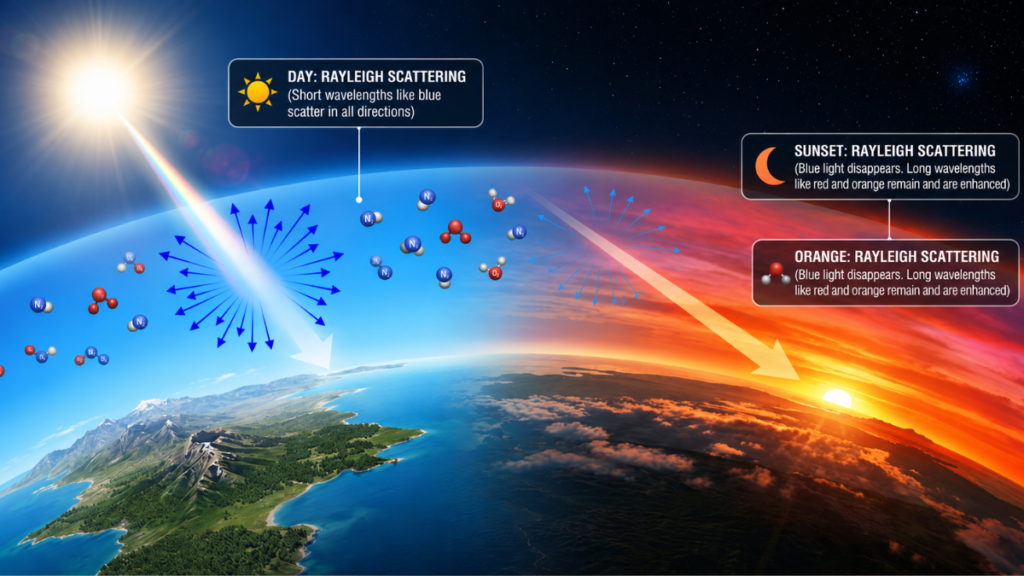
Have you ever wondered why the sky is blue and not green or violet? Discover the fascinating science of Rayleigh scattering and the hidden secret behind cinematic sunsets. A visual and scientific journey that will change the way you look up.
Have you ever found yourself staring at the sky on a random weekday and thought, ‘Hey, why is it this blue and not neon green or bubblegum pink?’ Don’t worry, you’re not alone. It happens to all of us. In fact, it’s one of those questions that seem like they’d be asked by a little kid, but which baffled the brightest scientists for centuries.
I’m someone who thinks that understanding the science behind what we see doesn’t take away the magic of it. On the contrary, it makes it a thousand times more incredible. It’s like knowing a magician’s tricks and still being amazed by the performance. Today we’re going to break down that magic trick the atmosphere gives us every day. Get ready, because we’re going to travel from the surface of atoms to the edge of the horizon.
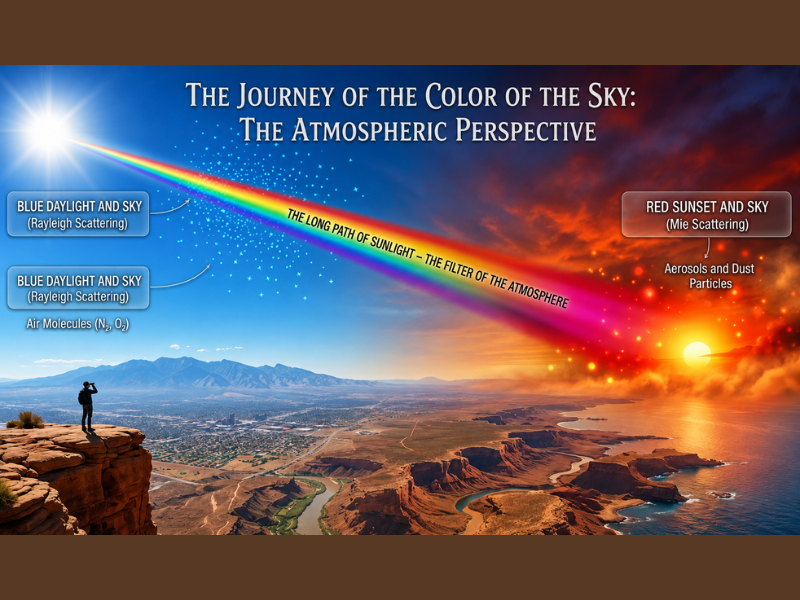
Quick summary of why the sky is blue
| Phenomenon | What color do we see? | What happens to the light? | Why does it happen? |
|---|---|---|---|
| Daytime Sky | Blue — and sometimes violet | Blue light “bumps into” air molecules and scatters in all directions. | Short path: Light passes through a small amount of atmosphere. Short wavelengths, like blue, bounce off gas molecules and fill the sky. |
| Sunset | Red, orange, and pink | Blue light gets scattered away and only warm colors pass through. | Long path: The Sun is low, so its light must cross much more atmosphere. Blue light scatters so much that it disappears before reaching you. |
| Cloudy Day | White or gray | All colors scatter equally. | Large particles: Water droplets are so large that they bounce all colors at the same time. The mixture of all colors appears white. |
| Sky on Mars | Pinkish during the day / Blue at sunset | Iron-rich dust changes the rules of the game. | Reverse effect: The Martian atmosphere is different, and its dust scatters light in a way that makes sunsets look bluish. |
1. Sunlight: The Great White Illusion
To understand why we see colors up there and why the sky is blue and the sunset red, we first have to understand what comes to us from outside. The Sun sends us light that we call ‘white.’ But, spoiler: white light is a master of disguise.
The Hidden Rainbow
White light is actually a mix of all the colors of the rainbow. Imagine that light is like a team of elite specialists, where each color has its own personality, its own energy, and, most importantly, its own “stride” or wavelength.
- Blue and violet are nervous, fast, with short, tight waves.
- Red and orange are calm, with long strides and stretched-out waves.
This difference in ‘rhythm’ is the key to the whole mystery. Without this mix, we would live in a black-and-white world (and honestly, pretty boring).
2. The Atmosphere: An Obstacle Full of Surprises
If the Earth didn’t have an atmosphere, the sky would be black as coal even during the day (you can ask the astronauts on the Moon, they see it that way). But we have a layer of gases (mainly nitrogen and oxygen) that acts like a giant filter.
Invisible Particles, Giant Effects
We often think of air as “nothing,” but it’s full of molecules. When sunlight reaches the Earth, it hits these gas molecules, and that’s where the biggest game of billiards in history begins.
Have you ever played pinball? Well, blue light is like a small, mischievous ball that bounces off everything and shoots off in all directions. Scientists call this phenomenon Rayleigh scattering, named after Lord Rayleigh, the guy who finally connected all the dots in the late 19th century.
3. Rayleigh Scattering: The Dance of the Photons
This is where we get serious (but not too much). Rayleigh scattering tells us that particles that are much smaller than the wavelength of light are going to scatter short waves much more easily.
Why is the sky blue?
Since blue has a short wavelength, when it “hits” the nitrogen molecules in our atmosphere, it bounces around like crazy. It spreads all over the sky. That’s why, when you look anywhere that’s not directly at the Sun, what you’re seeing is all that blue light that has bounced and is coming to you from every possible direction.
It’s an organized chaos of color flooding our vision. But wait, if violet has an even shorter wavelength than blue… why isn’t the sky violet?
The ‘failure’ of our eyes
This is one of my favorite parts. Physically, the sky is pretty violet. However, our eyes aren’t perfect machines. We have three types of color receptors (cones), and we’re much more sensitive to blue than to violet. Plus, the Sun emits more blue light than violet. So our brain, in a show of simplification, decides that the sky is blue. We’re programmed to see it that way!
4. Sunsets: When Light Takes the Long Way Around
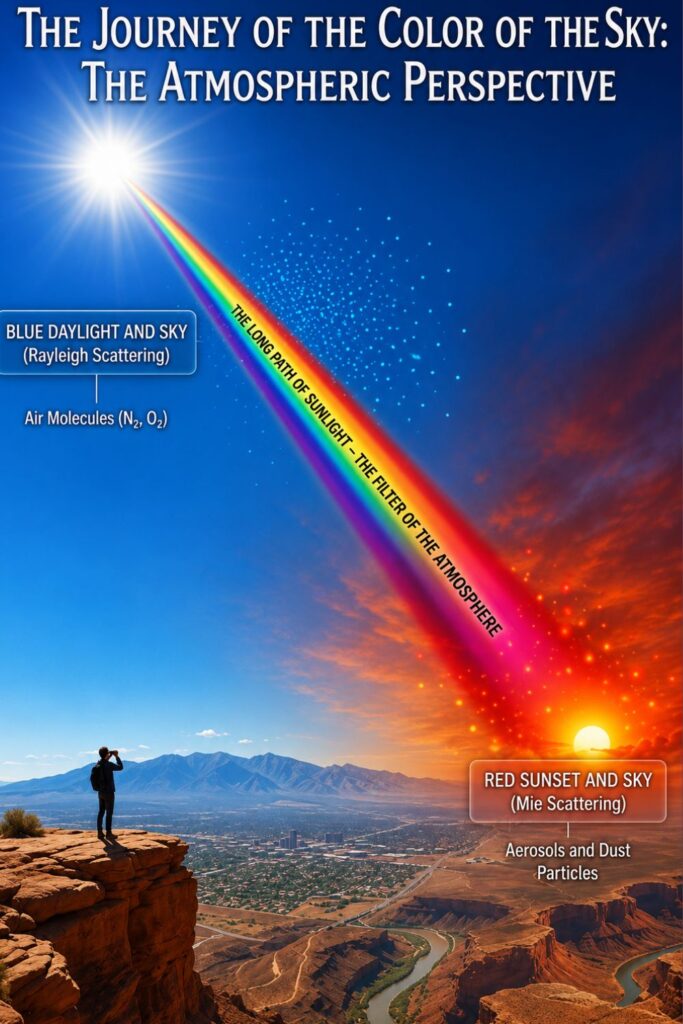
If we already understand why the sky is blue (because the ‘bouncing’ light is the short-wave one), what happens when evening comes? This is where the Earth’s geometry comes into play and gives us those colors that flood Instagram every day.
The Long Road of the Sun Rays
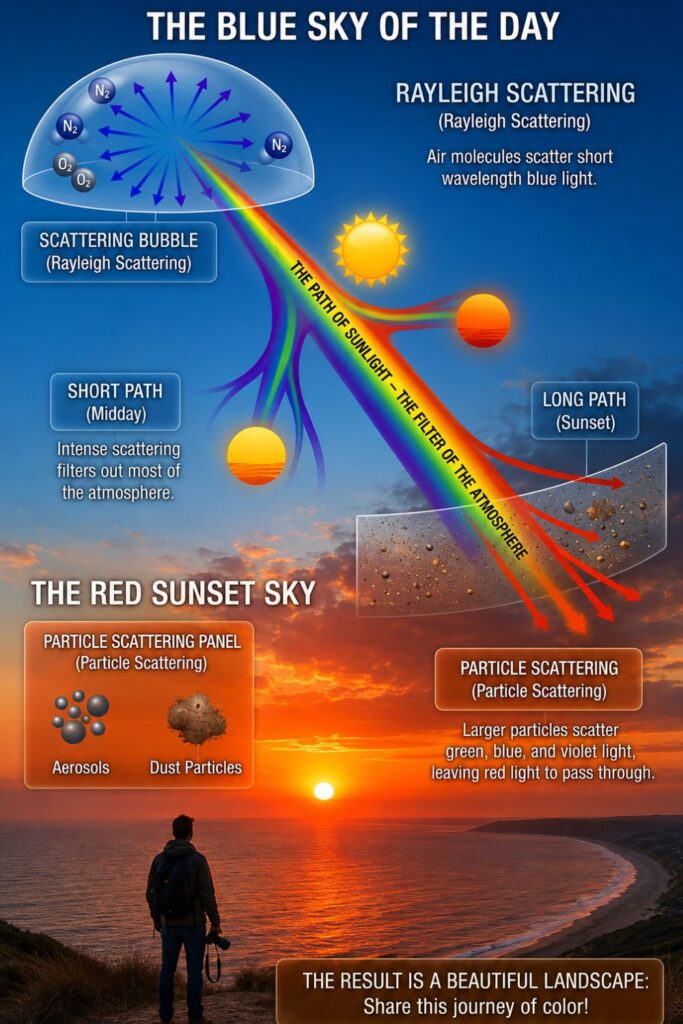
Imagine that the atmosphere is a swimming pool. At noon, the Sun is right above us, so the light passes straight through the layer of air, taking the shortest path. There’s little distance, and the blue light has time to bounce around and color everything.
But at sunset, the Sun is low, almost hidden on the horizon. To reach your eyes, that light has to pass through a much greater amount of atmosphere. It’s a much longer and tiring journey through denser layers of air filled with dust.
Red: The Last Color Standing
On this long journey across the horizon, something happens to blue light: it scatters so much, so much, that it ends up disappearing. It runs out. There are so many bounces that blue light gets lost along the way before it reaches you.
Who are the only ones that can handle the trip? The long-wave colors: red, orange, and pink. These colors are like heavy trucks that don’t get distracted by air molecules, they keep going straight and pass through all that layer of gas until they hit your eyes directly. That’s why, at the end of the day, the sky turns fiery. It’s literally the only thing left of sunlight after an exhausting journey.
5. Dust, Pollution, and Aerosols
ou’ve probably heard that sunsets in big cities or after a fire can look more spectacular — and it’s true, even if that sounds a bit grim
Dust, Ash, and Aerosols
When there are larger particles in the air (not just gas molecules, but dust, pollen, or pollution particles), another type of scattering occurs. These particles “trap” cold colors even more and let warm tones pass through in a much stronger way.
There’s even something called Mie Scattering, which happens when the particles are large (like water droplets in clouds). That’s why clouds look white or gray: they scatter all colors equally and don’t favor any. But when the sun is very low, those clouds act like a giant movie screen where the reds and oranges that managed to get through are projected.
6. And Why Is the Sky Blue and Not Green? The Million-Dollar Question
This is the kind of question that leaves you thinking in the shower. If the color spectrum goes: Blue -> Green -> Yellow -> Orange -> Red… why doesn’t the sky go through a lime green before turning orange?
The answer is that green scatters ‘too little’ compared to blue, but ‘too much’ compared to red. In the end, green ends up mixing with the others, and our eyes don’t perceive it as a pure color in the sky. It’s like if you mix everything really fast on a painter’s palette—the green just gets lost in the transition.
Although, if you’re super lucky and the air is incredibly clean, there’s a really rare phenomenon called the ‘green flash’ that lasts a second right when the sun sets. It’s like hunting a legendary Pokémon!
7. Visual Games: Be a Scientist in Your Living Room
You don’t need a NASA lab to see why the sky is blue in action. If you want to show off a bit with your friends or explain this to someone in a fun way, try this trick:
The Water Glass Experiment
Take a clear glass, fill it with water, and add just a drop of milk (or a bit of white liquid soap). Stir well. Now, grab a flashlight and shine it from one side of the glass.
- If you look at the water straight on (where the light hits directly), you’ll see that the liquid has a yellowish or orange tone. It’s your own sunset in a glass!
- If you look at the glass from the side, you’ll see that the water looks slightly bluish.
What’s happening? The particles in the milk are acting like an ‘atmosphere,’ scattering blue light to the sides and letting the red pass straight through to the other end. Magic, but with physics in the background.
8. What’s Happening on Other Planets? A Sky of Strange Colors
If you ever move to Mars (thanks to Elon Musk), get ready for a total mindset shift. On Mars, the atmosphere is very thin and full of iron-rich dust, essentially rust-colored particles.
The strange thing is that almost the opposite happens there: during the day, the sky has a pink or brown tone because of the dust, but sunsets on Mars are blue. Yes, you heard that right. Mars dust scatters light in such a different way that, when the Sun sets, the glow around the star is a cold, alien blue. It’s an upside-down world.
9. Frequently Asked Questions about Why the Sky is Blue and the Sunset is Red
Why is the sky blue and not black during the day?
Because we have air. Without an atmosphere, sunlight would travel in a straight line and we would only see light if we looked directly at the Sun. The rest of space would look black. The air “holds” the light and spreads it everywhere.
Does rain affect the color of the sky?
A lot. You must have noticed that after a good storm, the blue of the sky is much more intense and clear. That’s because the rain “cleans” the air of large dust and pollution particles, letting Rayleigh scattering (the one with gas molecules) take center stage.
Is the sea blue because it reflects the sky?
This is the most widespread myth in history, and I’m sorry to tell you that… no. The sea is blue on its own. Water absorbs red and orange wavelengths first, and what reaches our eyes is blue. Even if the sky were cloudy, if the water is clean and deep, you would see it as bluish.
Why is the sky blue and the clouds white?
Because the water drops in clouds are ‘giant’ compared to gas molecules. Being so big, they scatter all colors of light equally. And as we already know, mixing all colors results in white. When they turn gray, it’s simply because they are so dense that light can’t fully pass through them and they are in shadow.
I would love to know your opinion!
I hope that the next time you look up or get lost staring at a sunset on the beach (or on your home terrace, that works too), you remember Lord Rayleigh and those red photons that have battled against all odds to reach your eyes.
Were you surprised about the sky on Mars, or did you already know? Is there any other natural phenomenon that leaves you wondering, “why does this happen”?
Leave me a comment down below and tell me about the most incredible sunset you’ve ever seen. read every comment and always reply!

