
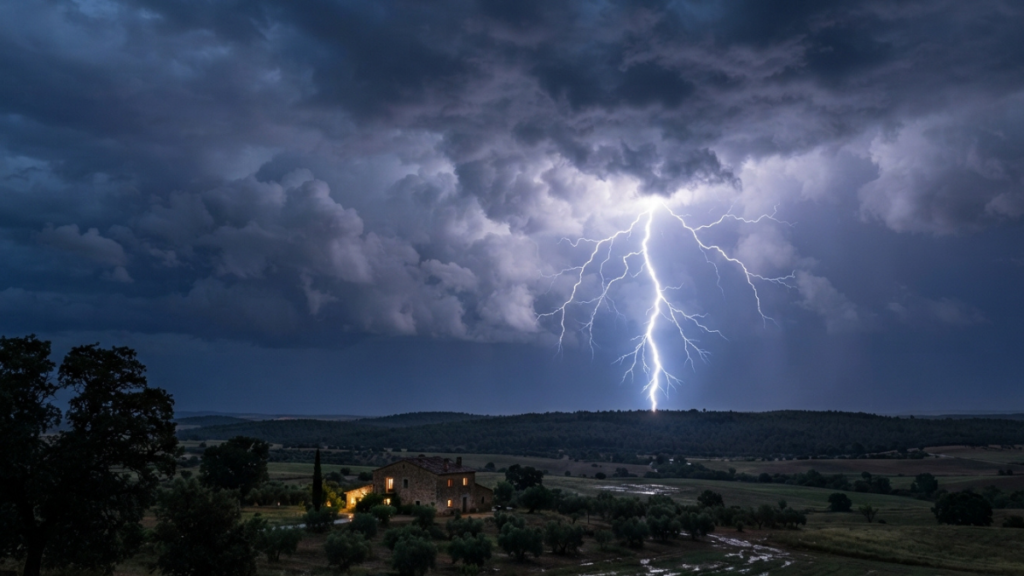
You know that moment when you’re home, a massive thunderstorm rolls in, and a flash of lightning fills your entire window? You brace yourself for the boom, but it doesn’t come. Not yet. You wait one second, two, five, and then it finally hits, this deep, chest-rattling rumble that shakes the glass.
That was me last night, standing in my kitchen with a lukewarm cup of tea while the lamp flickered from the sketchy power grid.
I caught myself staring out the foggy window, counting the seconds between flash and boom, and wondering why we always see lightning way before we hear it. It’s one of those things you never really stop to question because it just happens. But once you do, it turns out the answer is a pretty wild lesson in how the universe actually works.
If you’ve ever been curious about this, you’re in the right place. Understanding why light always crushes sound in a foot race is one of the coolest little tricks physics has to offer.
Images in this post were created for illustrative purposes using AI
Light vs. sound: the race that’s over before it starts
To get why this delay happens, picture the inside of a storm. Think of a dark summer sky as a giant stage, and the atmosphere as the seats where we’re all watching the show.
Now picture an enormous electrical spark ripping across the clouds. In that single millisecond, two things happen at once. A blinding flash of light (lightning) and a powerful shockwave of compressed air (thunder). Same place, same instant. They’re born as twins.
But the second they start heading toward you, they split up. It’s like racing a Ferrari against a shopping cart with a wobbly wheel. Light takes off at a speed your brain can barely comprehend. Sound? It trudges along, bumping into every air molecule on the way.
When you’re sitting on the couch watching the rain, your eyes and ears are basically working on two different timelines. Your retinas catch the flash almost instantly. Then, a few seconds later, you feel the rumble rattle your windows. That gap isn’t your brain glitching. It’s proof that different types of energy move through air at very different speeds.
The speed of light
Let’s talk numbers. Don’t worry, I’ll keep it painless.
Light is the fastest thing in the known universe. In the vacuum of space, it clocks in at about 186,000 miles per second. Inside our atmosphere, it slows down just barely because it bumps into gas molecules, water vapor, and dust, but for all practical purposes it’s still going about 186,000 miles per second.
How fast is that, really? The light from a single lightning bolt could lap the entire planet about seven and a half times in one second. So when a spark fires inside a cloud, the flash doesn’t “travel” to your eyes in any meaningful sense. It’s basically already there. You’re seeing the event at virtually the same moment it happens, with a delay measured in millionths of a second. Your brain rounds that down to zero.
Fun side note: this insane speed is also why we can look at distant stars and see them as they were millions of years ago. But that’s a story for another day.
The speed of sound
If light is a fighter jet, sound is a guy jogging. Comfortably. Maybe stopping for coffee.
Sound needs a physical medium to travel. Air, water, metal, whatever. It can’t cross the vacuum of space because there are no molecules out there to carry the vibration. It literally works by one air molecule crashing into the next, passing the energy along like a chain of bumper cars.
In dry air at room temperature, sound travels at roughly 1,125 feet per second, or about 767 miles per hour. That’s fast. Faster than most commercial planes. But compared to light? It’s not even in the same zip code.
While light crosses the sky in a literal blink, sound has to push through billions of nitrogen and oxygen molecules, each one slowing it down a tiny bit. So if a bolt hits a few miles away, the sound basically has to run a marathon to reach your ears.

Inside a thunderstorm: where the magic actually happens
Not every cloud makes lightning. For that, you need a very specific beast called a cumulonimbus. These are the towering monsters of the sky, starting as low as a mile above the ground and stretching up to ten or twelve miles high, punching right through the tropopause (the boundary between the troposphere and the stratosphere).
Inside one of these clouds, it’s total chaos. Warm, humid air rushes upward from the ground, shoving water vapor into the freezing upper atmosphere. Cold, heavy air sinks back down. This constant churn creates the perfect conditions for something called triboelectric charging, basically static electricity on a massive scale.
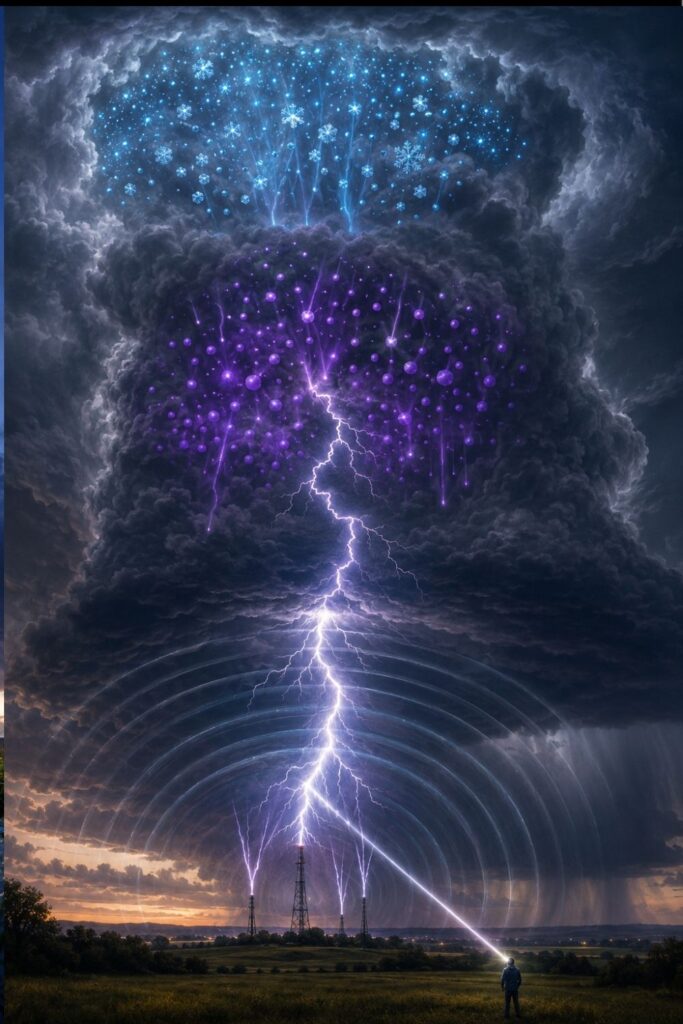
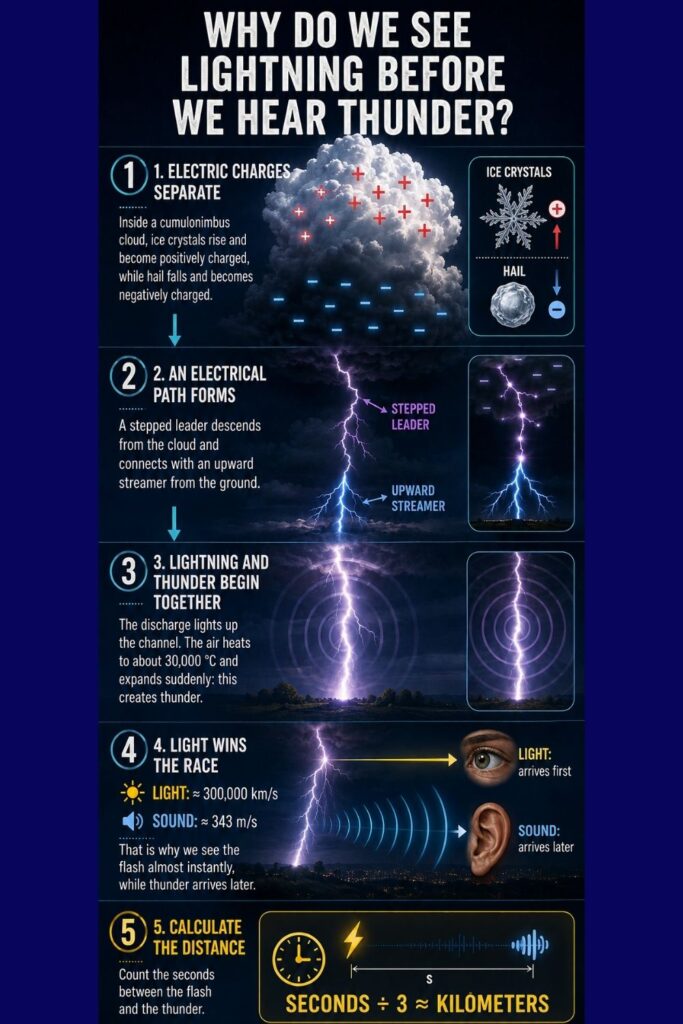
Picture trillions of tiny water droplets, ice crystals, and hailstones all smashing into each other at ridiculous speeds. Every collision transfers a tiny bit of electrical charge. The smaller, lighter ice fragments ride the updrafts to the top of the cloud and become positively charged. The bigger, heavier hailstones sink toward the bottom and go negative.
After a few minutes, the whole cloud turns into a giant battery floating in the sky. Positive charge on top, massive negative charge on the bottom. The air between the cloud and the ground, which normally acts as a great insulator, starts to break down under the pressure. Once enough charge builds up, the air ionizes, loses its insulating properties, and becomes a temporary conducting channel. That’s the moment lightning fires.
The invisible journey: how lightning finds its path before the flash
What looks like a single, instant flash from your window is actually a much more complex process. Lightning doesn’t just drop straight out of the sky. It builds itself in fractions of a second through a wild electrical choreography.
It starts when the negatively charged base of the cloud sends invisible channels of ionized air toward the ground. Physicists call these stepped leaders. They zigzag downward in quick jumps of about 150 feet at a time, blindly feeling around for the path of least electrical resistance.
Meanwhile, down on the ground, tall objects like trees, buildings, transmission towers, and mountaintops sense the incoming charge. They respond by sending their own positively charged channels upward. These are called streamers, or upward leaders.
When a downward leader connects with an upward streamer, the circuit closes. What happens next is called the return stroke: a massive electrical current, sometimes tens of thousands of amps, rockets from the ground back up to the cloud at roughly one-third the speed of light. That return stroke is what lights up the entire channel. That’s the flash you see.
The physics behind the delay
Once you know that lightning and thunder are born at the exact same time and place, the mystery comes down to simple kinematics. Two signals leave the same starting point at the same moment, but they travel in completely different ways.
Light is an electromagnetic wave. It doesn’t need air, water, or any physical medium to travel. It rips through the vacuum of space just fine. In our atmosphere, it barely slows down at all, cruising at about 186,000 miles per second. If a storm is three miles away, the light reaches your eyes in roughly sixteen millionths of a second. Your brain can’t even register a gap that small. It just feels instant.
Sound is a completely different animal. It’s a mechanical wave, meaning it needs a physical medium. It moves by compressing and decompressing air molecules in sequence, like dominoes falling in a line. Each molecule bumps the next, passing the energy along. That takes time.
At about 68°F, sound travels through air at roughly 1,125 feet per second. For that same three-mile storm, the sound wave needs about 15 seconds to reach your eardrums. So you’ve got sixteen millionths of a second on one side and fifteen full seconds on the other. That’s your delay.
How to figure out how far away a storm is
Here’s a fun trick you probably learned as a kid but might have forgotten: you can use this delay to estimate how far away a storm is. It’s dead simple, and it gives you a weirdly satisfying sense of control when nature is putting on a show.
Just count the seconds between the flash and the thunder. For every five seconds you count, the storm is about one mile away.
The five-second rule
The math is straightforward. Sound covers about 1,125 feet per second. In five seconds, that’s roughly 5,625 feet, just about a mile.
- One second? The storm is about 1,000 feet away. That’s close.
- Ten seconds? Roughly two miles out.
- Fifteen seconds? About three miles from your window.
I do this every time there’s a storm, whether I’m out in the country or just watching from the couch. If the count keeps getting shorter, the storm is heading your way. If it keeps getting longer, it’s moving away. It’s like having a low-tech radar built into your brain.
Thunder
If lightning is the visual headliner, thunder is the bass drop. But it’s way more than just a loud noise. It’s a shockwave. When lightning’s electrical current tears through the air, it heats the channel to about 54,000°F. That’s roughly five times hotter than the surface of the sun.
That extreme heat makes the surrounding air expand so fast it basically explodes. Think of it like over-inflating a balloon until it pops. The air gets violently compressed and then decompressed in a split second. That pressure wave is what you hear as thunder.
Here’s what’s interesting: thunder doesn’t sound the same up close as it does from far away. If you’re right next to the strike, you get a sharp, loud crack, almost like a gunshot. If the storm is miles away, it turns into that long, rolling rumble that seems to go on forever.
That’s because of echoes. The sound bounces off mountains, buildings, hillsides, and even different layers of air at different temperatures. By the time it reaches you from far away, those reflections have stretched it out into a deep, drawn-out growl.
Why storms still freak us out
I was talking about this with a friend the other day while we watched a downpour from the patio of a coffee shop. She said that even though she totally understands the science behind it, a close thunderclap still makes her flinch every single time. Honestly? Same.
For tens of thousands of years, our ancestors saw lightning and thunder as the work of angry gods or a furious natural world. We know better now. We know it’s just physics, electrical potential differences and electrons shuffling around. But our bodies haven’t gotten the memo.
A sudden, loud noise triggers your sympathetic nervous system instantly. Your body dumps a shot of adrenaline into your bloodstream and throws you into high alert. It’s an evolutionary reflex, and a useful one. No matter how much concrete and technology we surround ourselves with, it’s a little reminder that we’re still animals living in a wild, unpredictable world.
Frequently asked questions about lightning, thunder, and storms
Can you have lightning without thunder?
Yes, and it happens more often than you’d think. People usually call it heat lightning or silent lightning. The thunder is technically still produced at the source, but if the bolt is more than twelve to fifteen miles away, the sound waves lose so much energy traveling through the atmosphere that they fizzle out before they reach you.
It can also happen when layers of air at different temperatures bend the sound upward, away from the ground. You see the flash, but the rumble never arrives.
Does lightning really never strike the same place twice?
Total myth. In fact, it’s the exact opposite. Tall buildings, communication towers, and exposed mountain peaks get struck over and over again, every single storm season.
The Empire State Building in New York City is a perfect example. It gets hit by lightning dozens of times a year and suffers no real structural damage, thanks to its modern lightning rod system.
Why does thunder sometimes sound like a sharp crack and other times like a long, rolling rumble?
It depends on how far away you are and the shape of the bolt itself. Lightning isn’t a straight line. It’s a jagged, branching channel that can stretch for several miles.
If it strikes nearby, the sound from every part of the channel hits your ears almost simultaneously, so you hear one loud crack. If it’s far away, the sound from the top of the bolt arrives at a different time than the sound from the bottom. Add in echoes bouncing off terrain, buildings, and atmospheric layers, and you get that long, deep, rolling rumble.
Stay inside or keep watching the sky?
There’s something special about watching a thunderstorm from the safety of a covered porch or through a window. You’re seeing a physical phenomenon unfold at nearly 186,000 miles per second while you patiently wait for the sound to catch up. It’s a simple pleasure that puts the sheer scale of the world we live in into real perspective.
Next time you see a flash light up the horizon, try counting the seconds. It’s a tiny, quiet race between light and sound, and physics is running the whole thing behind the scenes. Take a second to appreciate how genuinely weird and wonderful this planet is.
So, are you the type who watches storms from the window with a cup of something warm, or do you hide under the blankets until it’s over? Drop a comment below. I want to hear your storm stories.

