
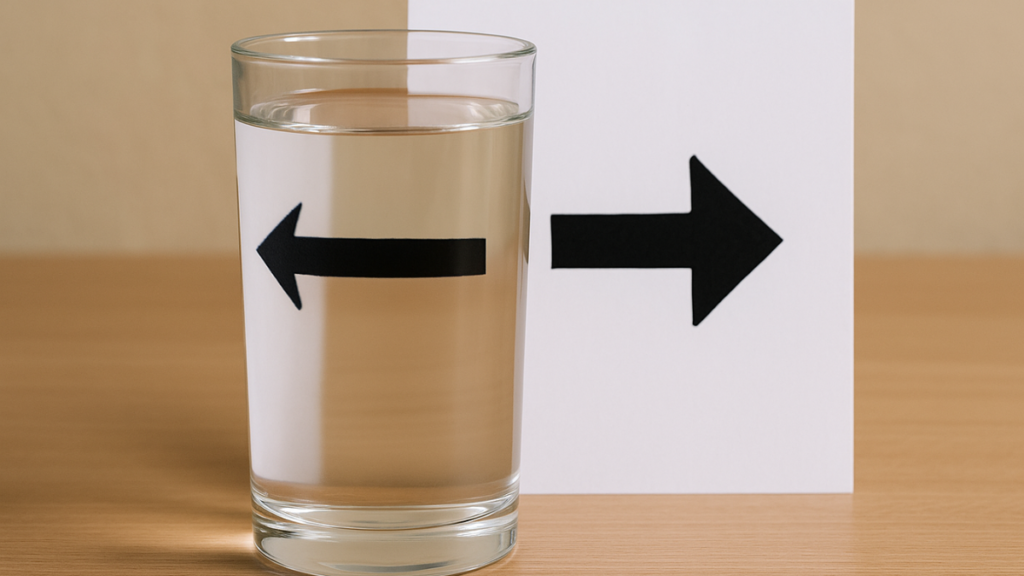
Discover light refraction through everyday examples and a surprising experiment: the arrow that changes direction when looked at through a glass of water. A clear, approachable, and scientific explanation.
We have always been told that light travels in a straight line. And that’s true… until it isn’t. When it passes from one medium to another, for example from air to water or from glass to air, light changes speed and, as a result, it changes direction. This phenomenon is called light refraction, and although it may sound very technical, we constantly see it without realizing it.
It is in rainbows, at the bottom of a swimming pool, in eyeglasses, in a magnifying glass, in a drop of water on a text… and also in that very simple, very puzzling experiment of the arrow that turns around.
Light refraction, explained without formulas
Refraction occurs when light passes from one medium to another and changes its speed. That change in speed causes the light ray to bend, meaning it no longer travels in a straight line
For example:
-From air to water.
-From air to glass.
-From water to plastic.
Each material has what is called a refractive index, which indicates how much it slows down light when passing through it. The more “optically dense” the material is, the more the light bends.
It does not mean that the material is heavy. It means that light interacts more with it.
Why our eyes can be fooled
Our eyes and our brain work together with a basic assumption: light travels in a straight line.
When light is bent, the brain does not correct the error. It simply extends the ray backward in a straight line and “places” the object somewhere it isn’t actually located.
That’s why:
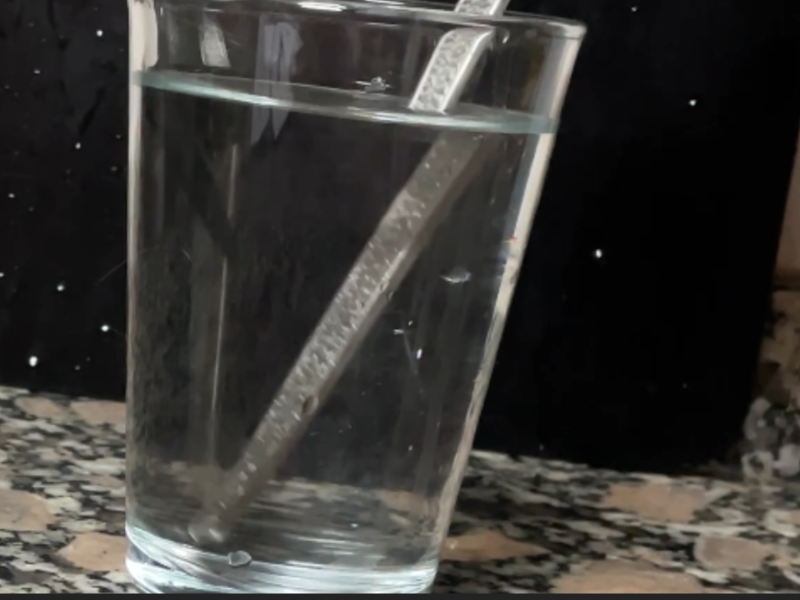
-A pencil inside a glass looks bent.
-The bottom of a swimming pool looks closer.
-A coin seems to move when water is poured.
-And an arrow can completely change direction.
It’s not that the arrow turns. It’s that the light reaching your eyes has changed its path.
Light refraction in everyday life, even if you don’t call it that
The swimming pool botton that tricks your eyes
You have probably stepped into a pool at some point thinking the bottom was closer than it really was. That is refraction. The light coming from the bottom bends as it leaves the water, and your brain misinterprets the depth.
That’s why it always seems less deep than it actually is.
The “broken” pencil in water
Classic, simple, and very revealing. You put a pencil in a glass and it looks like it breaks right at the surface of the water. In reality, the submerged part appears displaced because light changes direction when passing from water to air.
Nothing is broken. It’s all optics.
Glasses and lenses
Glasses work thanks to refraction. Lenses bend light in a controlled way so that images focus correctly on the retina.
Without refraction, we would not see well. It’s that simple.
A little history: when science began to explain how light bends
The refraction of light is not a modern discovery. Even in Antiquity, these effects were observed, but it was from the 17th century onward that scientists like Snell and Descartes began to mathematically describe how light behaves when passing from one medium to another.
The famous Snell’s law explains exactly how much light bends depending on the angle of entry and the material. But it is not necessary to know the formula to understand the phenomenon.
Why this phenomenon fascinates us so much
We like the refraction of light because it breaks a basic expectation: that what we see matches what is there. And that is not always the case.
It reminds us that seeing is not the same as understanding. That our senses are incredible, but also interpretive. And that science does not take away the mystery of the world, but gives us tools to enjoy it more.
When you see the arrow change direction, something awakens inside you. It is not just surprise, it is curiosity.
The arrow experiment: why it changes direction
This experiment is one of my favorites because it has everything I love about popular science: it is simple, surprising, cheap, and above all, very visual. You don’t need any prior knowledge or special materials. Just a glass, water, and a drawing. Even so, it makes you doubt what you are seeing for a few seconds.
The first time I did it with someone watching, the reaction was immediate: ‘That can’t be.’ And that is exactly where learning begins.
Materials needed
For this experiment you need:
- A transparent glass, preferably cylindrical.
- Water.
- A sheet of paper or cardboard.
- A marker.
- A stable surface.
Nothing more. The simpler, the better, because that way there is no suspicion of trickery.
How to draw the arrow
Draw a big, clear arrow pointing to the right or to the left. It doesn’t need to be perfect, just clear enough to understand the direction. It’s important that the arrow is horizontal, not vertical.
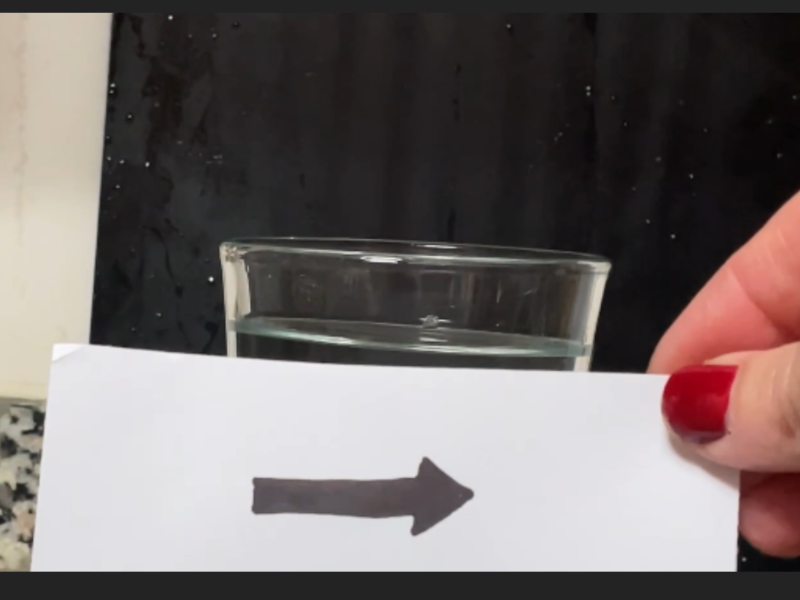
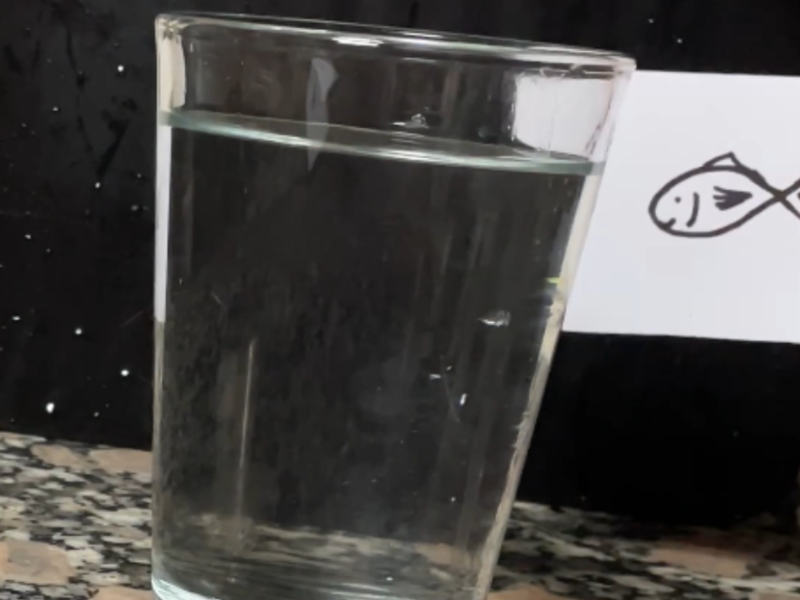
Place the arrow drawing behind the empty glass and look at it through the glass. You will see the arrow exactly the same as without the glass. Up to this point, nothing strange.
Now comes the key moment.
The ‘magic’ moment: adding the water.
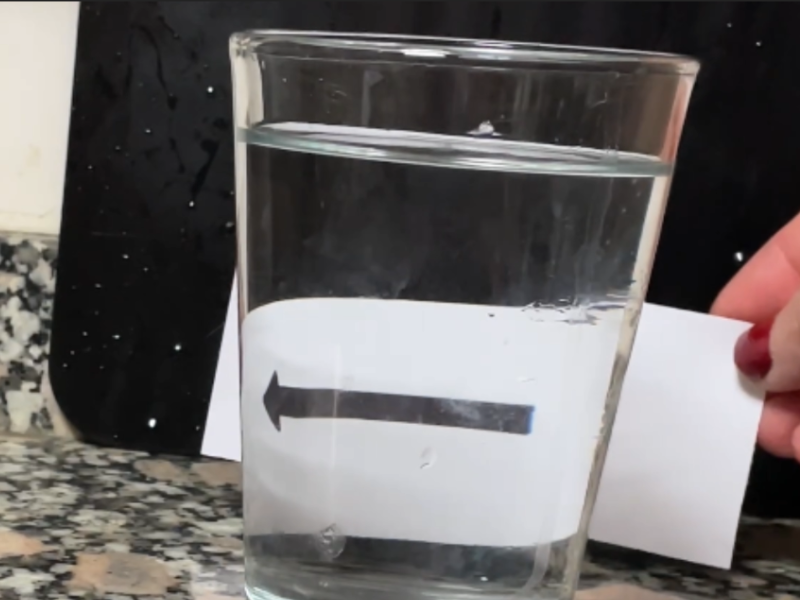
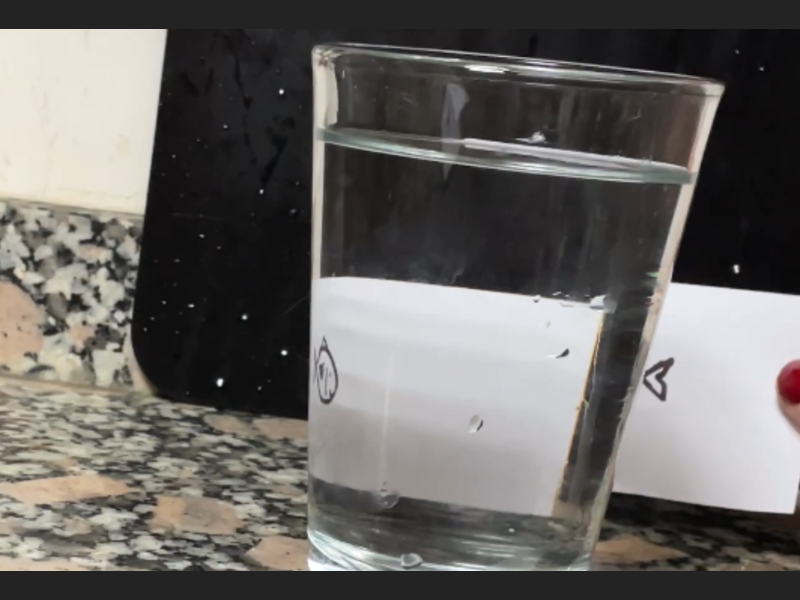
Fill the glass with water to the top. Place it back in front of the arrow, in the same position. Look at it again.
And there it happens. The arrow appears to point in the opposite direction.
It doesn’t move, the paper doesn’t turn, there are no mirrors. Just water and glass. But the image that reaches your eyes has completely changed.
Why exactly does the arrow change direction?
Here is the most interesting part. It’s not just that the image gets distorted, it’s that it flips horizontally. And that has to do with the shape of the glass and how light rays behave when passing through it.
The role of the glass as a cylindrical lens
A glass full of water is not just a container. Optically, it behaves like a cylindrical lens. It does not focus the same in all directions, only in one.
When the light from the arrow drawing passes through the glass and water, it bends several times:
- when entering the glass.
- when passing from the glass to the water.
- and again when it exits into the air.
Each change of medium alters the path of light rays.
The important thing is that the rays coming from the left side of the arrow cross with those from the right side inside the glass. That crossing causes the image to reach your eyes inverted.
The brain does not correct the refraction of light.
The brain does not correct for light refraction.
Why this experiment only works horizontally
Many people try to turn the arrow vertically and are surprised to see that it no longer flips. That is no coincidence.
The inversion occurs because the glass acts like a horizontal cylindrical lens. It bends the light from left to right, but not from top to bottom. That is why the inversion only occurs along that axis.
If the glass were spherical, the effect would be different. And if we used a convex lens, even more so.
Variations of the experiment to help you understand it better
One of the best ways to learn is to try small variations and observe what changes.
Change the distance.
Move the glass closer to and farther away from the drawing. You will see that the inversion remains, but the sharpness changes.
Use glasses of different thickness.
A wider glass produces a clearer inversion than a very thin one. The greater the curvature, the greater the deviation of light.
Try other liquids.
You can try oil, water with dissolved sugar, or salt water. It will slightly change the effect because each liquid has a different refractive index.
Try using letters instead of arrows.
The letters deform, widen, or partially invert. It is very curious to observe.
Each test adds a new layer of understanding.
What scientific concepts you are learning without realizing it
With this very simple experiment, you are touching on very powerful ideas:
- Refraction of light.
- Refractive index.
- Wave propagation.
- Image formation.
- How lenses work.
- Visual interpretation by the brain.
Everything without formulas, without equations, and without stress.
Light refraction and the conservation of energy
Even though light changes direction, it does not disappear nor is it created out of nothing. It simply changes its trajectory and speed when passing through different media. Energy is conserved.
This is important because it shows that refraction is not a visual trick without a physical basis. It is a direct consequence of how light interacts with matter.
Water does not ‘deceive’ light. It slows it down, redirects it, and lets it continue on its path.
Real-world applications of this phenomenon
Refraction is not just a nice experiment. It is in many devices and real situations:
- Cameras.
- Microscopes.
- Telescopes.
- Glasses and contact lenses.
- Optical fiber.
- Prisms and spectroscopes.
Every time a lens focuses light, refraction is quietly at work.
More everyday examples of refraction (because it is everywhere).
Once you understand what happens with the arrow and the glass, you start to see everything with different eyes. Literally. The refraction of light ceases to be an isolated concept and becomes a kind of mental filter to interpret the world.
Raindrops and rainbows
Every raindrop acts like a small lens. Sunlight enters, refracts, reflects inside the drop, and refracts again as it exits. The result is the separation of the colors that form the rainbow.
It’s not that the rainbow is there waiting. It’s the light that reorganizes as it passes through the water.
Pools that trick the eye
We already mentioned it before, but it deserves to be brought up again. The bottom of a swimming pool always seems closer than it is. Refraction makes the rays of light exit the water deflected, and your brain reconstructs the image as if the bottom were higher up.
That is why you should never rely only on what you see underwater
The thick glass and displaced objects.
If you look at an object through thick glass, you will notice that it is not exactly where it seems. It’s not that the glass has defects. It’s that the light has changed speed and direction.
This happens in shop windows, display cases, old windows, and aquariums.
Common myths about light refraction
“Light bends because water pushes it”
Not exactly. Light is not pushed. It changes speed when it enters a different medium, and that change causes the bending.
“It’s an optical illusion without any real basis”
False. Refraction is a perfectly measurable physical phenomenon, with clear laws and very real technological applications.
“It only happens with water”
No. It can happen with any transparent or translucent material.
“Our eyes correct the bending”
They do not. The brain assumes straight paths and reconstructs the image accordingly, even if it is incorrect.
Why this experiment works so well for learning science.
The arrow experiment works because:
- Breaks a clear expectation
- It is immediate and visual
- It does not need prior explanation
- It generates an automatic question
- It has an elegant scientific answer
You don’t need to convince anyone that it is interesting. The surprise does the work for you.
What you are training besides learning optics
Although it may seem like just a curious experiment, you are actually training very important skills:
- Attentive observation
- Critical thinking
- Ability to ask questions
- Understanding of mental models
- Difference between perception and reality
This is science in its purest form, but presented in a friendly way.
Frequently asked questions about light refraction
Why does the arrow invert and not just deform?
Because the light rays cross inside the glass due to its cylindrical shape. That horizontal inversion is a direct consequence of the geometry of the system.
Does it work with any glass?
It works better with cylindrical and transparent glasses. Very thin or irregularly shaped glasses can reduce the effect.
Does the type of water influence?
Yes, slightly. Changing the density of the liquid alters the refractive index, although the effect will still be visible.
Can it be done with children?
Yes, it is a safe and highly recommended experiment, always with supervision and adapted explanations.
Does this have to do with lenses?
Totally. It’s the same principle that lenses use to focus or bend light.
When seeing is not understanding
The refraction of light reminds us of something fundamental: seeing is not always understanding. Our eyes do what they can, but reality is richer, more complex, and more interesting than it seems at first glance.
That moment when the arrow changes direction is not just a visual trick. It is an invitation to question, to observe more closely, not to take for granted what we believe is obvious
This experiment shows how the refraction of light can reverse the direction of an image when passing through a glass full of water. It is simple, visual, and very effective for understanding how the path of light changes.
Total Time: 2 minutes
Draw a large horizontal arrow on the sheet, making sure the direction is clear
Place the paper upright on a stable surface
Place the empty glass in front of the drawing and look at the arrow through the glass to check that it appears normal.
Fill the glass completely with water without moving the paper.
Look again through the glass and observe how the arrow seems to change direction.
Tools:
- glass cup
- paper
- marker
Materials: water
Editorial note
If you do the arrow experiment, tell me how you or the people with you reacted. I love hearing those first words of disbelief.
Were you surprised? Did you try variations? Did you explain it to someone else?
Science is much more enjoyable when shared.

