

Discover what the Doppler effect is and how it explains everything from the sound of an ambulance to the expansion of the universe. A complete, fun, and informative guide to understanding the science of motion and waves.
You’ve probably heard an ambulance pass by at some point and noticed how the sound of the siren changes: first high-pitched, then lower. Or perhaps you have seen a star moving away in space and wondered why its light changes color. What connects these two very different moments is something amazing: the Doppler effect, a small but great key to understanding motion, sound… and the universe itself.
When a siren tells you science
It all started on an ordinary morning, I was walking down the street, distracted, when an ambulance sped past. That sudden change in sound pulled me out of my reverie: at first it sounded high-pitched, then deeper, as if the sound itself were bending in the air.
For a few seconds, I couldn’t help but smile. That small change in tone was more than just a simple auditory effect, it was physics unfolding right in front of your ears.
What the Doppler effect really is
In simple words, the Doppler effect occurs when a wave source (it can be sound, light, or any other type of wave) moves relative to you.
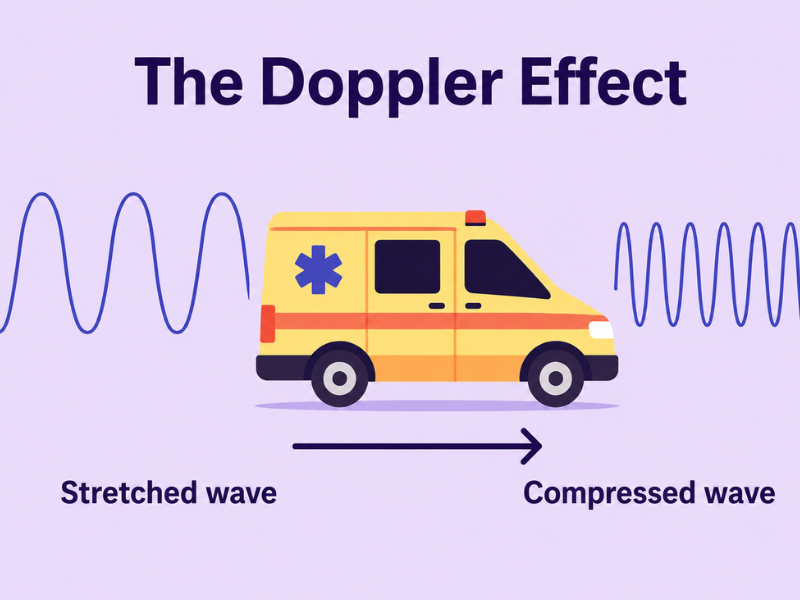
When the wave source approaches, the waves are compressed, and when it moves away, they are stretched out. This makes the frequency you perceive change, even though the source always emits the same sound or light.
Imagine that waves are like sea waves. If the boat that produces them moves toward you, the waves arrive more frequently (high frequency = high-pitched sound). If it moves away, they take longer to arrive (low frequency = low-pitched sound).
And that, precisely, is what you hear with a siren, a train, or even what you observe in space with the light from the stars.
The sound that changes in tone (and in story)
The fascinating thing about the Doppler effect is that it was not invented by a 21st-century physicist, but rather described by a curious Austrian back in 1842, Christian Doppler. He was a professor and had an obsession: understanding why stars showed different colors when observed from Earth.
Of course, in his time there were no modern ambulances or fast trains, but there were waves, and Doppler had the brilliant intuition that motion could change the way we perceive those waves, whether they are sound or light.
Hardly anyone believed him at first. But a few years later, another scientist, Buys Ballot, conducted a legendary experiment: he placed musicians playing the same note on board a moving train, while others listened from the ground. The result? Exactly, those on the outside heard the note higher when the train approached and lower when it moved away. The proof was so clear… that the Doppler effect ended up in all physics books.
How you notice it in your daily life
Ambulances and police cars
You’ve probably experienced this before: the sound of the siren seems to ‘drop’ in pitch just as the vehicle passes by. It’s not that the siren changes, but your perception of the sound. As the vehicle approaches, the waves compress, so the sound has a higher frequency (sharper notes). As it passes and moves away, the waves stretch out, the frequency drops, and the sound becomes deeper.
trains and airplanes
The Doppler effect is even more noticeable when the vehicle is fast. Have you ever heard a train pass through the station without stopping? That whistle that seems to slide from a high note to a low one is Doppler in action.
And the same happens with airplanes; as they approach, their roar seems louder and higher-pitched, and as they move away, it becomes softer and deeper.
Sometimes, in air shows or air races, this effect is so intense that it seems as if the sound splits in two.
Traffic radar
Yes, even fines have physics behind them. Traffic radars use the Doppler effect to measure speed. Instead of sound, they use radio waves. They send a signal that bounces off the car and returns altered: if the vehicle is approaching, the frequency increases; if it is moving away, it decreases. With that difference, the radar calculates the exact speed.
The Doppler effect in space
This is where everything becomes even more interesting. The Doppler effect not only changes sound, it also affects light. And that detail allowed astronomers to understand that the universe is in constant motion.
The shift toward red and blue
When a star or galaxy moves away from us, its light shifts to longer wavelengths, that is, toward the red of the spectrum. And when it approaches, the light shifts toward blue (shorter wavelengths). This phenomenon is called redshift or blueshift.
It is exactly the same principle as with sound, but instead of tones, we talk about colors.
Thanks to these observations, the astronomer Edwin Hubble confirmed in the 1920s that distant galaxies are generally moving away from us. That discovery changed the history of science; the universe is not static, it is expanding.
The stars that move
Nowadays, astronomers use the Doppler effect to measure the speed of stars and planets. They even detect exoplanets by observing the wobble of a star as it moves slightly due to the attraction of its planet. That oscillation causes a tiny change in the color of the light… but enough to know that there is something orbiting around.
The physics behind all of this
I know that sometimes the word “physics” can be a little scary, but in this case it is simple if you think of it as something visual.
Waves (of sound, light, or any type) have two main properties:
- Wavelength: the distance between two consecutive peaks.
- Frequency: how many waves pass through a point each second.
When something moves toward you, the waves compress (high frequency, short wavelength). When it moves away, they stretch out (low frequency, long wavelength). And the basic formula that describes it is this:
f’ = f × (v ± vo) / (v ∓ vs)
where:
- f’ is the perceived frequency,
- f the emitted frequency,
- v the speed of sound or light,
- vo the movement of the observer,
- vs the movement of the source.
Don’t worry, you don’t need to memorize it. Just understand that the key is in how the frequency changes when there is relative motion.
When hearing and sight get confused
There is a curious detail, our brain associates high frequency with closeness. That is why, when we hear a high-pitched sound approaching, we feel a certain tension or alertness. And when it becomes low-pitched, we feel that it moves away and that everything calms down.
It is a learned reflex. For thousands of years, our ancestors used that subtle change to perceive danger or movement.
In a way, the Doppler effect is also part of our auditory biology.
Myths and curiosities about the Doppler effect
One of the great things about the Doppler effect is that it feels so familiar that many people take it for granted… but there are also quite a few myths going around.
Here are some that I usually hear, and that I always like to clarify.
Myth 1: ‘The Sound Changes Because the Siren Does’
No, the ambulance siren does not change its tone. What changes is the frequency at which the waves reach your ears. If you record the siren from a fixed point, you will see that the sound remains constant, even though you perceive it differently when it passes by.
Myth 2: ‘The Doppler effect only occurs with sound’
False, it also happens with light, radio waves, microwaves, and practically any type of wave. What is important is not the type of wave, but the relative movement between the source and the observer.
In fact, without the Doppler effect applied to light, we would not know that the universe is expanding.
Myth 3: ‘Only scientists can understand it’
Another classic. And I love debunking this one because the Doppler effect is one of the easiest things to perceive with your own senses. You have heard it countless times, and astronomers have observed its effect in light from stars and galaxies.
Historical anecdotes: how a train and an orchestra made history
One of my favorite anecdotes about the Doppler effect is the one about Buys Ballot’s experiment in 1845. He wanted to demonstrate whether Christian Doppler’s theory about waves was correct, so he gathered a group of musicians with trumpets, put them on a train, and had them play the same note while moving at full speed.
On the platform, a group of scientists listened carefully. And yes, they confirmed it: the note sounded higher as it approached and lower as it moved away. It was the first time that science “literally” sounded different depending on the position.
Modern applications of the Doppler effect
Today the Doppler effect is used far beyond theoretical physics. It is in medicine, meteorology, technology, and even in video games.
In medicine
Have you heard of the Doppler ultrasound? It is a medical technique that uses ultrasound waves to see how blood flows in the veins and arteries. Thanks to the Doppler effect, blockages or circulation abnormalities can be detected without the need for surgery.
The principle is the same: when blood approaches the sensor, the frequency of the waves increases; when it moves away, it decreases.
In meteorology
Doppler radars allow detecting storms, rain, and even the speed of the wind inside a cloud. When raindrops move, they change the frequency of the waves they reflect. This way, meteorologists can see the direction and strength of the wind, and predict storms accurately.
In traffic and sports
In addition to speed radars, the Doppler effect is also used in sports measurement systems. For example, to calculate the speed of a tennis ball or a car in a race. The principle is always the same: movement changes the reflected frequency of the emitted waves.
In astronomy and space exploration
In space, the Doppler effect is literally a universal language. The radio waves sent by space probes are also affected by this phenomenon. That is why engineers can know whether a spacecraft is moving away from or approaching Earth by analyzing the change in frequency of its signal.
It is impressive to think that a discovery from almost two centuries ago is used today to measure the speed of entire galaxies and of spacecraft millions of kilometers away.
How you can observe the Doppler effect yourself
I propose a small experiment to see it in action without leaving home.
- Record with your mobile the sound of a motorcycle or car passing nearby.
- Play the audio and notice how the tone changes right when the vehicle passes in front of the microphone.
- If you want to make it more visible, use a sound analysis app and you will see the frequency curve go up and down.
You can also try with a light source (for example, a flashlight with a color filter), and an optical sensor if you have advanced curiosity. You will see that, although the change in the light is imperceptible to the eye, the instruments do detect it.
Little-known curiosities
- Bats use a “natural Doppler effect” to navigate. They emit ultrasound and listen to how it bounces back. When the prey moves, the change in frequency indicates its speed and distance to them.
- Police radar guns work thanks to the same principle as Doppler ultrasounds. Change the sound for microwaves and there you have it.
- Astronomers have detected invisible double stars thanks to the Doppler effect, because the change in their light reveals that something is pushing or pulling them.
- The effect is also used in video games and movies. If you hear a plane or car passing ‘for real’ in surround sound, it is because the designers have digitally simulated Doppler.
How our way of seeing the universe changed
Before the Doppler effect, it was thought that the universe was static. Thanks to it, we understood that galaxies are moving away from each other and that space itself is expanding. In a way, every ray of light that comes from the cosmos tells us a story of movement.
And all because an Austrian professor, curious and stubborn, decided to look at the stars and wonder if color had something to do with their speed.
Frequently asked questions about the Doppler effect
Why is it called the ‘Doppler effect’?
By Christian Doppler, the Austrian physicist who proposed it in 1842. His idea was to see how motion affects waves, and it ended up changing our way of understanding sound, light, and the universe.
Does it only happen when the source moves?
No, it can also happen if you move toward or away from the source. The important thing is that there is relative movement between both.
Why does sound change pitch, while light changes color?
Because the ear interprets frequencies as musical notes and the eye interprets them as colors. It is the same principle applied to different senses.
Can the Doppler effect be seen with the naked eye?
With sound, yes (you hear it immediately). With light, no, because the changes are too small for the human eye. But with telescopes and sensors, it is measured perfectly.
Can it affect mobile signals or GPS?
Yes, although very slightly. The satellites and antennas correct those small frequency changes caused by movement to keep communications stable.
The movement that unites everything
The Doppler effect is one of those scientific gems that reminds you how beautiful physics is when you see it in action. It’s in the sound of the street, in the music of the wind, and even in the light of the stars. Every time something moves, the universe slightly changes its frequency… and we perceive it.
If you ever find yourself mesmerized listening to an ambulance pass by or looking at the night sky, you already know that you are perceiving the Doppler effect in action. Would you like to try recording it or doing a home experiment to check it? Tell me about it in the comments or on social media.
And remember: curiosity is the highest frequency of knowledge. 💜