
Discover why mixing lemon and baking soda releases carbon dioxide. Learn how this acid-base chemical reaction works, what makes it so special, and how you can take advantage of it at home. Fun, natural science full of curiosity.
There is something almost hypnotic about watching a liquid start to bubble nonstop when mixed with a white powder. You don’t need to be a chemist to feel curious when you see a glass full of sparkling foam. The best part is that you don’t need a laboratory, just a lemon and some baking soda. What seems like magic… is actually pure science in action.
What happens when you mix lemon and baking soda
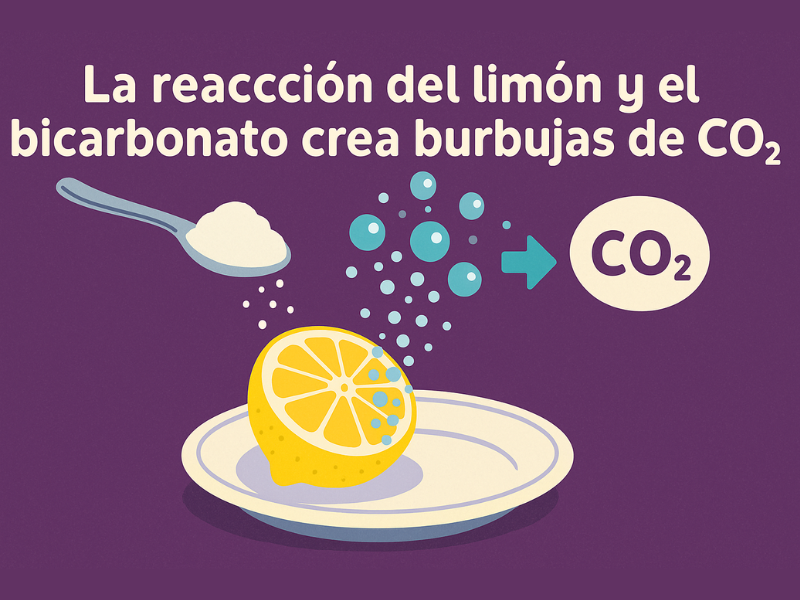
When you mix the juice of a lemon with baking soda, an acid-base chemical reaction occurs.
The lemon contains citric acid, a natural acid found in many fruits. Baking soda, on the other hand, is a weak base (its chemical name is sodium bicarbonate or NaHCO₃).
When they come into contact, they immediately react, releasing carbon dioxide (CO₂), an invisible gas that forms the bubbles and foam you see.
The satisfying fizzing sound you hear is, in reality, the CO₂ escaping from the liquid, the same thing that happens when you open a soda bottle, only here you create it from scratch.
A little more science
I know the word “chemical reaction” can sound intimidating, but I promise you don’t need to have the periodic table memorized to understand what is happening.
Basically, the citric acid in the lemon (H₃C₆H₅O₇) reacts with the baking soda (NaHCO₃). In this process, the acid “gives up” protons (H⁺) and the bicarbonate “accepts” them. By doing so, the bicarbonate breaks down and produces carbon dioxide (CO₂), water (H₂O), and sodium citrate, a salt.
The complete reaction, if you want to see it in a more “formal” way, would be something like this:
H₃C₆H₅O₇ + 3 NaHCO₃ → Na₃C₆H₅O₇ + 3 CO₂ + 3 H₂O
But in everyday language this means:
lemon + baking soda = bubbles + water + salt (harmless)
Why it feels cold to the touch
If you notice, when touching the glass or the plate where the reaction occurs, you may notice that it is a little colder than before, that happens because the reaction is endothermic, that is, it absorbs a little bit of heat from the surroundings while it occurs.
In other words, the system “takes” energy from its surroundings in order to be able to produce the gas and the other compounds, so the mixture cools slightly.
How to do the experiment at home (step by step)
Now for the fun part. You don’t need anything you don’t already have at home.
Materials
- 1 lemon.
- 1 or 2 tablespoons of baking soda.
- (Optional) a little food coloring to make it more visual
Step by step
- Cut the lemon in half and squeeze it a little so that the juice comes out.
- Gradually add the baking soda while observing what happens.
- Look at how the effervescence begins: bubbles, foam, crackling.
- If you want to make it more spectacular, add a little food coloring, to see how the gas rises among the colors.
And that’s it. You have created an acid-base reaction that produces visible CO₂ in the form of bubbles. If you do it with children or friends, everyone ends up fascinated by it. It’s a little science show that always amazes ^^


Improved version: the lemon volcano
If you want to take the experiment a step further, you can create a mini fizzy volcano. You just have to cut the top of a lemon, place a little baking soda on the surface, and use a straw or dropper to add more juice on top.
The mixture will start to come out like foamy white lava. It’s the same principle, just visually much more fun.
What we learn with this experiment
Although it may seem like a game, this experiment teaches several basic chemistry concepts in a visual and memorable way.
- Acid-base reactions: the citric acid from the lemon reacts with the base of the baking soda.
- Gas production: carbon dioxide is released as a visible gas.
- Endothermic reactions: the mixture absorbs heat and cools down.
- Chemical transformations: the initial compounds are transformed into new ones, although they remain safe.
The best part is that these concepts only seem difficult until you see them in action.
What is special about carbon dioxide?
CO₂ (carbon dioxide) is a fascinating gas. We breathe it, release it, use it to make fizzy drinks, and it is also in the atmosphere. In this experiment we see it “born,” but in reality, it is everywhere.
When you mix lemon and baking soda, each bubble that rises to the surface is full of CO₂ trying to escape. If you do it in a closed container, you can even inflate a balloon with the gas that is generated.
Everyday uses of lemon and baking soda
The curious thing about this reaction is that it is not only a fun experiment, but it also has very practical applications in daily life. We use it without realizing it every time we clean, cook, or try to neutralize an odor.
“Lemon and Baking Soda in Home Cleanin
Baking soda is a classic for cleaning due to its alkaline nature, while lemon, being acidic, helps disinfect and break down grease. When you mix them, the released CO₂ helps lift dirt, especially on tough surfaces or in the joints of the bathroom and kitchen.
I usually test it with a sponge: I put a bit of baking soda, add a few drops of lemon, and let it sit for a few seconds before scrubbing. The mixture bubbles a little, makes that soft effervescent sound, and somehow you feel that it’s working.
Lemon and Baking Soda in the Kitchen
This duo also appears in recipes, although many times we don’t realize it. Have you noticed that some pastry dough rises without yeast? That happens because baking soda, when it reacts with an acid like lemon or yogurt, releases CO₂, and those gas bubbles get trapped in the dough, making it rise and become fluffy. Each bubble is like a small air chamber that expands with the heat of the oven. The result: softer and lighter cakes.
Lemon and Baking Soda to Neutralize Odors
Another interesting application is its ability to neutralize odors. Baking soda absorbs the acids that produce bad smells, and lemon breaks them down with its acidity and fresh scent. If you mix both and let them act in the refrigerator or in the bathroom, the effect is immediate. It is not an explosive reaction, but a small silent chemical dance that leaves the environment clean and fresh.
Curiosities about this lemon and baking soda reaction
There are many curious details that make this reaction something more fascinating than it seems, here I leave you some that I usually tell when I do the experiment with children or in workshops:
- The same gas that comes out here, CO₂, is the one we exhale when we breathe, so, in a way, our own internal bubbles work the same.
- CO₂ is heavier than air, which is why the bubbles tend to accumulate and do not disappear immediately. If you leave a container full of bubbles still, you will see that the foam takes a while to go down.
- The reaction can be repeated several times, as long as acid and base remain available. If it stops, just add a little more lemon or baking soda, and it will reactivate.
- It is completely safe. It does not produce toxic gases or hazardous waste; the most that can happen is that you run out of baking soda before time.
- It is the same reaction that occurs in old CO₂ fire extinguishers, where an acid and a base generated the gas that smothered the flames..
What happens if you change the proportions of lemon and baking soda?
Here comes a fun part for the most curious.
If you put too much baking soda and little lemon, you will see that the reaction is slow and there are almost no bubbles.
If you do the opposite, a lot of lemon and little baking soda, the bubbles appear quickly but run out quickly.
The key is balance: when the acid and the base are in similar amounts, they neutralize completely and the effect is more intense and long-lasting.
What is magical about this lemon and baking soda experiment?
Although we already know that there is no magic in the literal sense, there is something that reminds us of it. What we see (the bubbling, the foam, the crackling) are the visible signs of something invisible: the movement of atoms and molecules.
When I teach this experiment, I always say that science is the most honest way to perform magic, because it shows you the tricks and still leaves you amazed.
Frequently asked questions about the lemon and baking soda experiment
Can I use vinegar instead of lemon?
Yes, vinegar is also an acid (acetic acid), and mixing it with baking soda produces the same reaction. The difference is that vinegar smells stronger and has a less pleasant taste, so if you do it with children or for a more visual experiment, lemon is usually the more convenient option.
Is it safe to touch the mixture?
Totally, it is a mild and non-toxic reaction. That said, avoid rubbing the skin for too long because the acid can irritate a bit. And if you have small wounds or sensitive skin, it’s better to use a spoon or thin gloves.
Why does it stop bubbling?
Because the acid and the base neutralize each other. Once the lemon has reacted with all the available baking soda (or vice versa), there is no material left to continue generating gas. You can reactivate it by adding more of one of the two ingredients.
Can I inflate a balloon with this lemon and baking soda reaction?
Yes, and it is one of the most fun versions. Put a little baking soda inside an empty balloon, attach it to the neck of a bottle with lemon juice, and let the baking soda fall inside. You will see how the balloon inflates little by little with the gas that is generated.
What other acids are useful?
Any mild acid: vinegar, orange juice, yogurt, or even carbonated soft drinks.
The citric acid from lemon is ideal because it is natural and strong, but not aggressive.
Small derived experiments
If you liked this lemon and baking soda experiment, you can try variations that teach other interesting things:
- The volcano of colors: use different food colorings and mix several lemons at once. You will see how the bubbles get colored and mix.
- The bubble race: prepare several glasses with different amounts of baking soda and observe which one reacts fastest.
- The reverse experiment: first add baking soda to the water and then the lemon, little by little. This way you can control the speed of the reaction.
The Science Hidden in Everyday Life
Every time I repeat this experiment, I am equally amazed at how something so simple can explain so much.
The reaction of lemon and baking soda speaks to us about balance, energy, transformation, but it also reminds us that science is everywhere, even in any kitchen.
You don’t need a laboratory to feel like a researcher, just the desire to observe, touch, ask questions, and be surprised.
If you try this experiment, tell me how it turned out for you—did it bubble a lot? Did you manage to inflate a balloon? Or maybe you made your own lemon volcano?
I would love to read about your experiences in the comments and see your photos if you feel like sharing them.