
Learn how to blow out a candle without touching it with two homemade experiments: covering it with a glass and creating carbon dioxide with baking soda and vinegar. Scientific explanation, step by step, safety, variations, frequently asked questions, and curiosities.
The magic begins with a tiny flame
I have always liked candles. Not only for their warm light or scent, but because a flame is a small universe in motion. It is hypnotic, but also powerful and delicate at the same time. I thought about how we usually blow out candles without thinking: puff, fingers, candle snuffer, the usual. But what if there were another way? One that did not depend on force or contact, but on understanding how it works.
Before starting: what is really happening in a burning candle
The science behind a candle is more interesting than it seems. It is not simply wax melting; it is a continuous chemical reaction. For a flame to exist, it needs three things:
- Fuel, which in this case is wax, mainly composed of hydrocarbons.
- Sufficient heat to maintain combustion.
- Oxygen available in the air surrounding the candle.
This is called the fire triangle. If one element is missing, the flame disappears. There is no way around it. Fire is precious, but very obedient to its rules.
When the wax melts, it rises up the wick and vaporizes. That combustible gas reacts with the oxygen in the air, producing light, heat, water vapor, and carbon dioxide. In a way, the candle “breathes,” even though it has no lungs. In fact, it is almost a perfect metaphor: if you take away the air, the flame cannot continue.
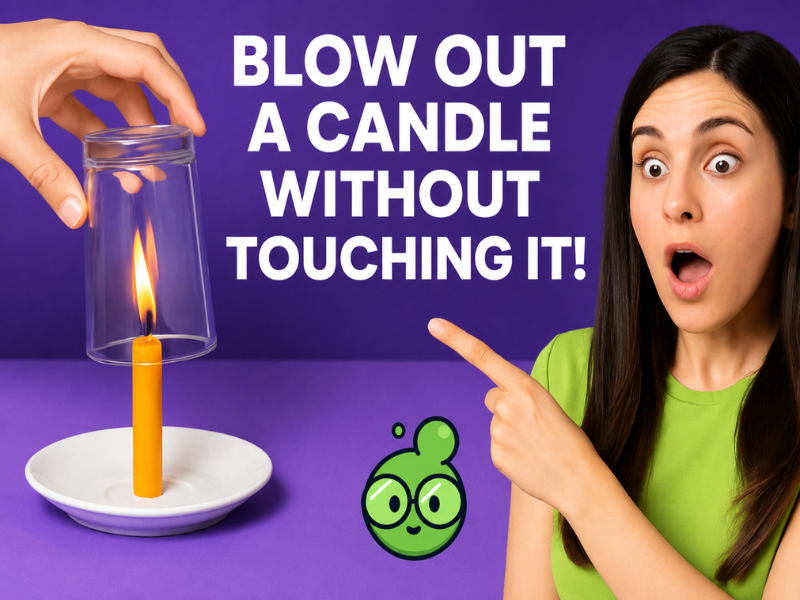
Experiment 1: Put out a candle without touching it by covering it with a glass
This experiment is one of those that leaves you with a silly smile. It doesn’t require strength, complicated tools, or mysterious ingredients, and visually it is spectacular, especially if you add colored water. It’s the perfect kind of demonstration for a dinner table, a class, a birthday, or simply to feed curiosity.
Simple, no-fuss materials
- A candle, preferably small and stable.
- A clear glass.
- A plate or tray.
- Lighter or matches.
- Optional water, with or without coloring.
With just that you can do a bit of science magic and blow out a candle without touching it.
How to do it step by step
- Place the candle in the center of the plate.
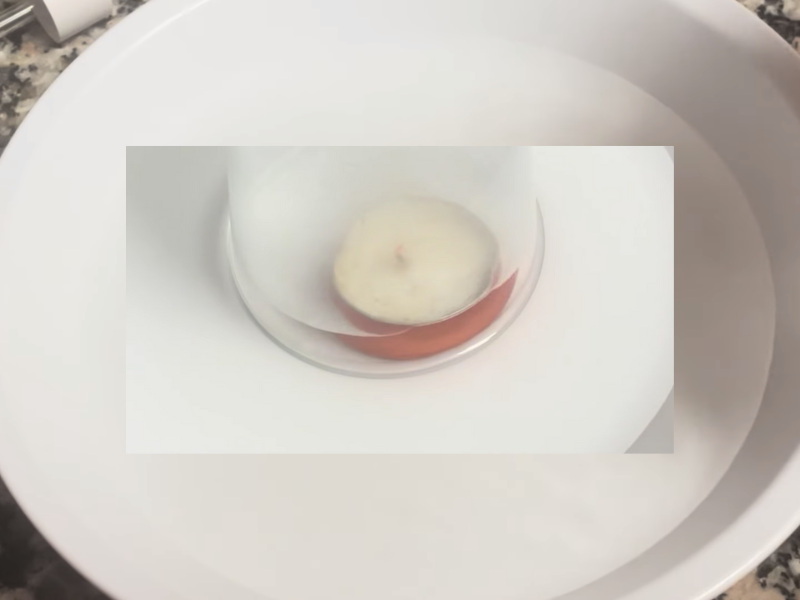
- If you want a visual effect, pour a little water on the plate, enough to cover the base.
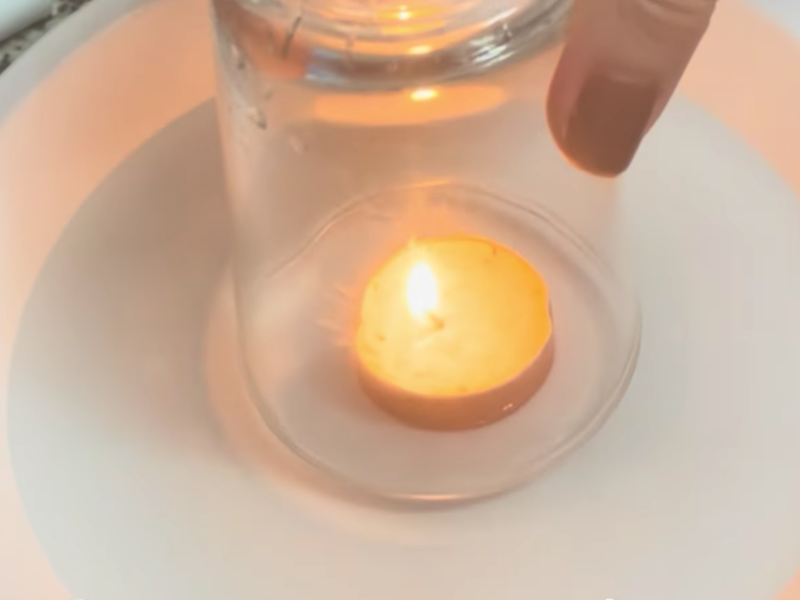
- Light the candle and let the flame stabilize.
- Hold the glass and cover it slowly, resting it on the plate.
- Calmly observe what happens during the following seconds.
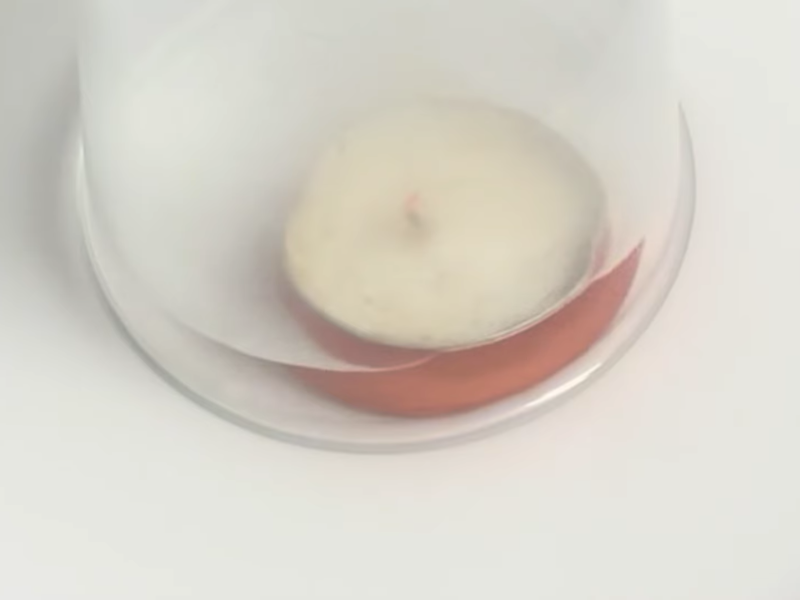
First, the flame will continue to burn as if nothing. Then, it will begin to get smaller, less defined, and finally, it will slowly go out. There is no blowing, no sudden smoke, no drama. Just an elegant extinction.
The scientific explanation
When you cover the candle with the glass, something invisible begins to happen. The candle continues consuming oxygen, but the glass prevents new air from entering. The interior space has a limited amount of oxygen and, as it burns, it decreases. At the same time, carbon dioxide is generated, which does not allow the combustion to continue.
A point is reached where the flame no longer has enough oxygen to sustain itself, it loses energy and goes out. Not because the candle “gets tired,” but because one of the conditions it needs to keep burning is gone.
Also, the hot air inside the glass begins to cool when the flame is turned off, which reduces the internal pressure. If there is water on the plate, the external pressure pushes the water into the glass and it rises, creating a beautiful effect.
What you can observe if you pay a little more attention
This experiment is so short that sometimes we do it quickly and miss fascinating details:
- The flame changes color slightly before going out.
- The wick stays incandescent for a few seconds.
- The water rises progressively, not suddenly.
- If the glass is large, it takes longer to go out because there is more oxygen.
It is a great opportunity to train the scientific eye. There is no need to measure anything, just look calmly.
Basic but necessary safety to extinguish a candle without touching it
Although the experiment is simple, fire always deserves respect. Some recommendations:
- Place the candle on a stable, heat-resistant surface.
- Do not do it near curtains, dry leaves, or paper.
- If there are children, let them participate, but do not let them handle the flame.
- Do not use thin glasses for long periods, they could get too hot.
- Keep water or sand nearby in case you need to extinguish the candle quickly.
Science does not have to be frightening, but it should not be taken lightly either.
What this experiment teaches beyond the result
The nice thing about this trick is not only that the candle goes out without touching it, but also what it reveals:
- Air has composition, it is not empty.
- Oxygen is essential for combustion.
- Gases occupy space and exert pressure.
- Chemical reactions are always present, even if we do not see them.
- Everyday objects can become learning opportunities if you know how to look.
Experiment 2: Put out a candle without touching it using baking soda and vinegar
If the glass experiment is elegant, this one is more noisy, spontaneous, and almost theatrical. Here we do not enclose the candle, we do not limit its space, we do not cover it. We simply let chemistry do its work around it. And although the flame seems safe, suddenly, it goes out without anyone touching it. The scene is perfect to film, because no one expects it.
Materials that you probably already have at home
- A small or medium candle.
- A glass, cup, or bowl.
- baking soda.
- Vinegar, preferably white.
- A wide plate or tray.
- Lighter or matches.
- Optional: dye to make the reaction more visually striking
How to put out a candle without touching it step by step
- Place the candle in the center of the plate and make sure it is stable.
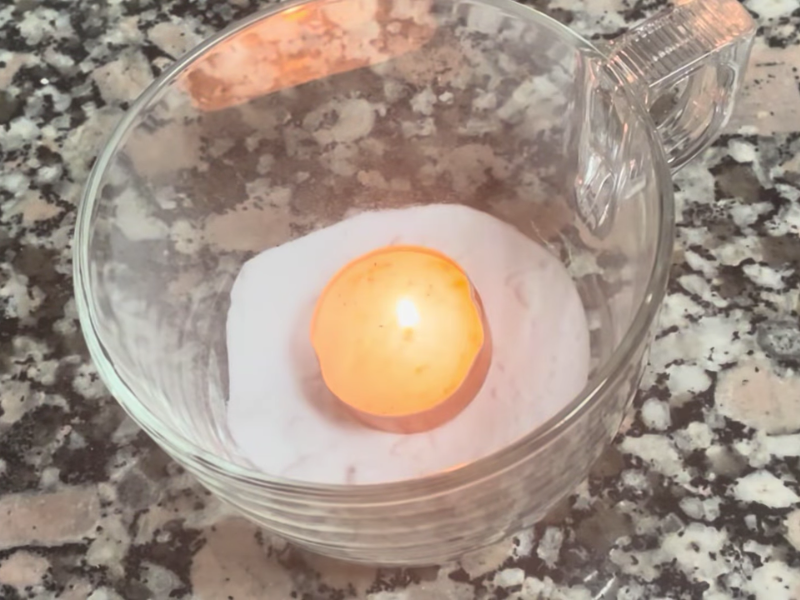
- Light it and let the flame be steady, not moving too much.
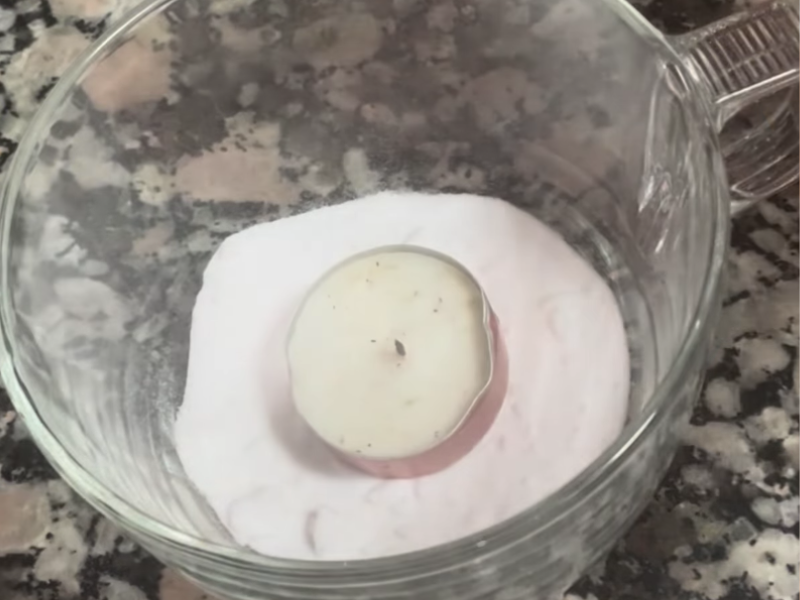
- Sprinkle baking soda around the candle, leaving space so as not to pour it on top.
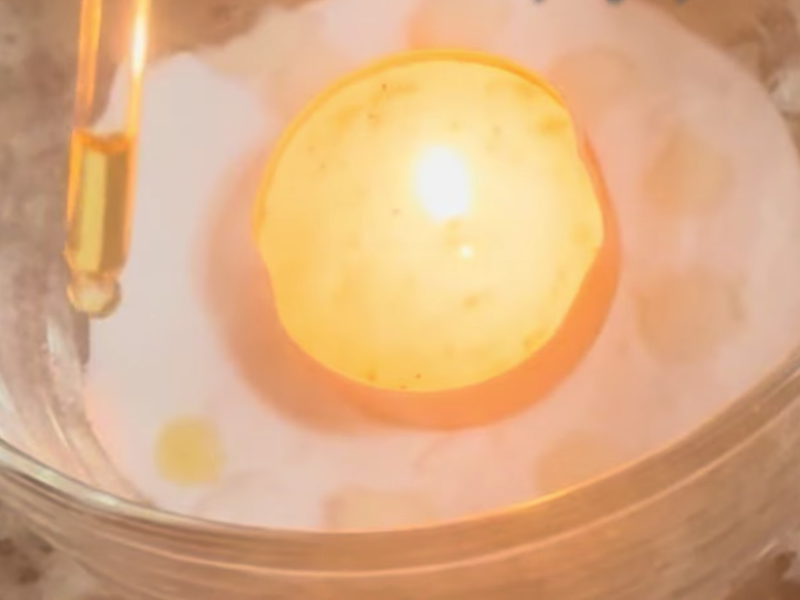
- Pour a little vinegar over the baking soda and step back slightly.
- Watch as foam, bubbles, and movement begin to form.
- Wait a few seconds. The flame will shrink, flicker, and go out.
The chemical reaction between baking soda and vinegar begins to release CO₂ almost instantly. If the container is deep, you can even see how that invisible gas seems to accumulate like a low cloud surrounding the candle.
Why it works: chemistry explained
Vinegar contains acetic acid and baking soda is a base. When you mix them, they neutralize each other and produce several products: water, sodium acetate, and carbon dioxide. That same CO₂ is responsible for the bubbling and for extinguishing the candle.
The reaction, written formally, would be like this:
CH₃COOH + NaHCO₃ → CH₃COONa + H₂O + CO₂
It is not necessary to memorize the equation, but you do need to understand that the process releases gas. This gas is heavier than air, so it sinks and displaces the oxygen around the flame. The fire triangle appears again: without oxygen, there is no combustion.
The flame does not go out from contact, or moisture, or because vinegar splashes. It goes out because the air around it no longer has enough oxygen.
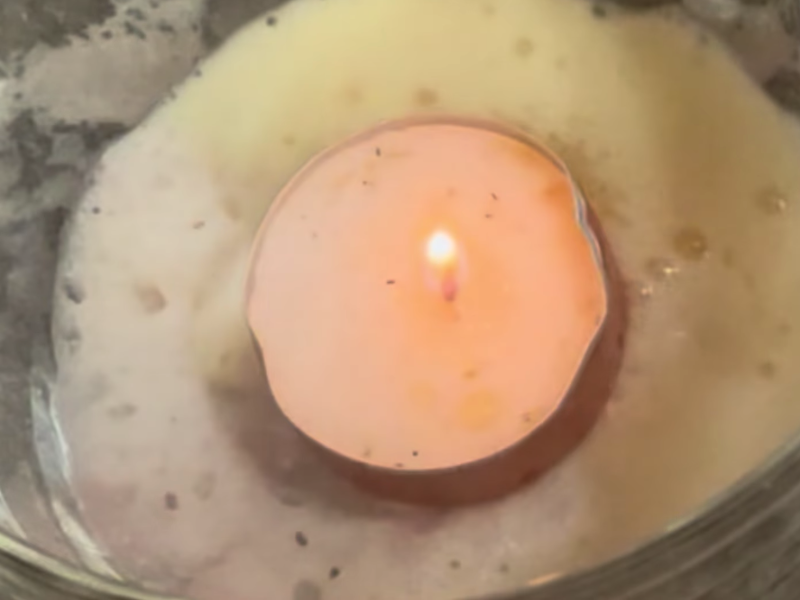
You can watch the experiment on video if you prefer:
https://youtu.be/jrnJEaCXM1w?si=AYeHjEACnRAY-szM
Details worth observing in this experiment
This experiment may seem quick, but it has many interesting layers if you stop to look:
- The flame usually leans slightly before going out, seeking oxygen.
- The intensity of the bubbling does not influence the extinction time as much as you think.
- If you use a deep container, you can even “pour” the CO₂ over the candle without pouring any liquid.
- Sometimes, the candle goes out before the effervescence ends.
It’s almost a detective game. Each repetition teaches you something different.
Comparison between both experiments: two ways to extinguish a candle without touching it
Although the result is identical, what happens, scientifically, is different.
In the glass experiment
Oxygen is depleted because the candle consumes it and new air cannot enter. The pressure also changes. It is the physics of air and combustion.
In the baking soda and vinegar experiment
We don’t trap oxygen, we displace it. We create new CO₂ that takes its place.
It’s chemistry, gas production, and density.
Both are complementary, like two chapters of the same series. And together they teach much more than they seem.
Curious and very useful variations to continue experimenting
Change the size of the candle
A taller candle takes longer to go out because it needs more time for the CO₂ to reach it.
Use glasses of different volumes
The extinction time will give you information about the amount of trapped oxygen.
Add color to the vinegar
It seems silly, but it helps to visualize the reaction, especially if you do it with children or with visual people.
Use bottles instead of glasses
A bottle can trap more CO₂ and lets you “see” it fall when you tip it toward the candle
Try it outdoors and indoors
The wind, the ventilation, and the temperature change the outcome.
Each variation provides clues. Science advances this way: with small but precise questions.
Safety to enjoy the experiment with peace of mind
Although these experiments are simple, fire always deserves caution.
Do not leave the candle burning unattended.
Do not bring your face close to the flame or the reaction.
Avoid unstable or flammable surfaces.
If you do the experiment with children, set clear boundaries.
When you finish, make sure the candle is completely extinguished.
Sometimes, we think that domestic things are harmless, but safety is always an indispensable companion.
Real applications: from the classroom to the industry
It may seem like we are playing, but these experiments connect with very real technologies.
- CO₂ extinguishers work exactly like this: they displace oxygen.
- Kitchens use acid-base reactions to generate gas in doughs and sauces.
- In laboratories, CO₂ is used to create controlled atmospheres.
- In wineries, the gas produced by fermentation displaces oxygen and can be dangerous without ventilation.
- The food industry uses CO₂ to help preserve textures and flavors.
Science is not isolated. It seeps into every corner of the everyday world, even if we do not always see it.
Common myths about extinguishing a candle without touching it
“The candle goes out because the baking soda wets the wick”
No direct contact occurs. What acts is the CO₂ displacing the oxygen.
“The glass creates a vacuum and sucks the water”
It is not empty. It is a decrease in atmospheric pressure due to the consumption of oxygen and the cooling of the air.
“Vinegar and baking soda explode”
Not in these amounts. The reaction is mild and controlled.
“If the water rises, it means that the glass is airtight”
Total airtightness is not necessary. It is enough to limit air exchange.
Debunking myths is a wonderful way to learn.
Frequently asked questions about extinguishing a candle without touching it
Can I use lemon instead of vinegar?
Yes, because it is also acidic. The reaction will be milder and may take a little longer.
Does it matter if the baking soda is expired?
It will work, although it could produce less gas.
Is the generated CO₂ dangerous?
Not in these quantities and in ventilated spaces. It is minimal, domestic, and temporary.
Why does the flame seem to stretch before going out?
Because it is trying to find oxygen. Fire also reacts to the environment.
Can a candle be extinguished using only CO₂ without mixing anything?
Yes, you can catch it in a container and pour it over the candle. It is an even more visual experiment.
Curiosities that you might not know about blowing out a candle without touching it
- Carbon dioxide not only blows out candles, it also preserves food because it displaces the oxygen that oxidizes them.
- Firefighters are familiar with these dynamics because intense fires can rapidly consume oxygen in enclosed spaces.
- Complete combustion produces less smoke than incomplete combustion, which is why a candle that is going out changes color.
- Air is composed of approximately 21% oxygen, but the candle needs much less to begin to extinguish.
- If the glass is very large, the candle can last more than a minute before going out.
This experiment shows how a candle can go out on its own when it runs out of oxygen when you cover it with a glass. It is a visual, simple experiment, perfect for explaining combustion.
Total Time: 5 minutes
Place the candle in the center of the plate
If you want a more visual effect, add a little water to the plate.
Light the candle carefully.
Place the glass upside down covering the candle and resting it on the plate.
Watch how the flame starts to become smaller and smaller.
Wait a few seconds until the candle goes out on its own.
Materials: 1 small candle 1 glass 1 plate Water (optional) Matches or lighter
Science is not far away, it is on your table
What I like most about these experiments, like extinguishing a candle without touching it, is that they put something very simple on the table: to learn science you don’t need a laboratory with test tubes. Sometimes, a lit candle, a glass, a bit of baking soda, and the will to observe are enough.
It is not necessary to understand all the formulas to be amazed. It is enough to see how the flame bends, disappears, returns, changes color. Every detail tells a story about gases, energy, reactions, and balance.
So, if you have a candle nearby, try it, and then tell me what you saw, how long it took to go out, what those with you thought. Because science does not stay in books: it is shared, discussed, experimented with, and enjoyed.
If you feel like doing either of the two experiments, I would love for you to come back and tell me about it. Did the candle go out quickly? Did you try with different glasses? Did you add color to the vinegar? Were you surprised by the result of extinguishing a candle without touching it?
You can leave your experience, questions, or ideas in the comments, and if you know someone with infinite curiosity, share it with them.
Small experiments can lead to big science. 💜

